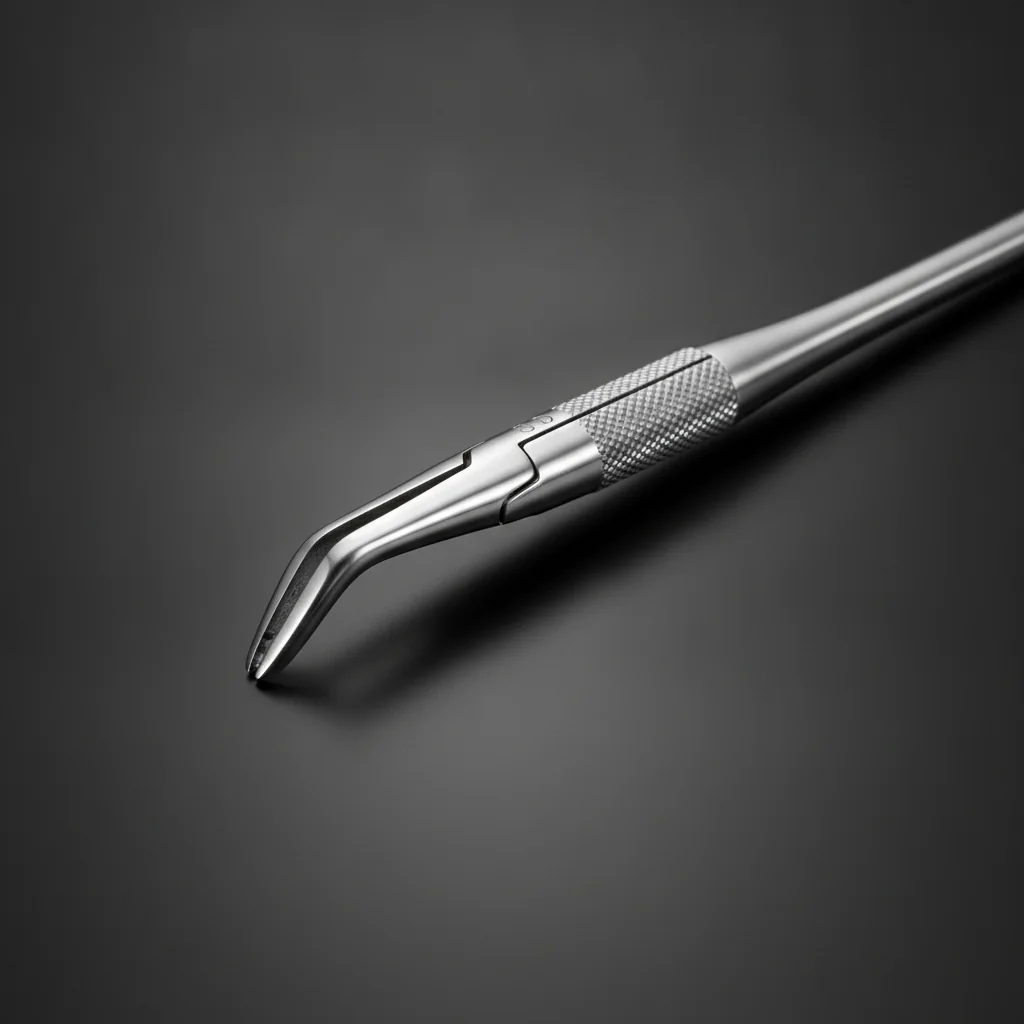
Probes & Directors — Pattern and Clinical Use
A probe explores; a director guides. The probe is a fine malleable rod with a rounded tip used to follow a tract without creating a false passage, while the grooved director has a channel along its length that a scalpel blade rides in, so tissue can be divided along a controlled line without cutting deeper than intended. The two are frequently supplied as a combined double-ended instrument.
Malleability is a deliberate specification on probes: the operator bends the instrument to follow the tract. That requires a steel temper that takes a bend without springing back or fracturing, which is a different requirement from the hardened tempers used on cutting instruments.
Probes & Directors Variants and Specifications
Standard probe and director patterns.
| Variant | Specification / use |
|---|---|
| Grooved director | Channels a blade along a controlled path |
| Probe, malleable | Traces sinus tracts and fistulae |
| Double-ended probe/director | Both functions in one instrument |
| Eyed probe | Draws a seton or ligature through a tract |
| Bulbous tip | Reduces risk of creating a false passage |
| 13–20 cm lengths | Matched to tract depth |
Material, Finish and Quality Control
We forge probes & directors from 316L austenitic stainless. Temper is set so the probe bends to follow a tract without springing back or fracturing, and tips are polished smooth to avoid creating a false passage. Each batch passes Rockwell hardness testing, dimensional checks on temper and tip smoothness, and visual inspection under our ISO 13485 system before passivation and final finishing. Mirror and satin finishes are both available — satin is usually specified where glare under operating lights is a concern.
Who Sources Probes & Directors From Surgical Star
Probes and directors sell into general, colorectal and ENT sets, and into podiatry for sinus exploration. They are inexpensive, long-lived items that reorder steadily rather than in volume.
OEM, Certification and Ordering
Every probes & directors can be produced as a private-label line: your logo laser-marked on the shaft, your catalog numbers, and your own printed packaging, manufactured from your drawings or a reference sample. Our quality file is ISO 13485, our EU route is CE marking under MDR 2017/745, and our facility holds US FDA establishment registration. Conformity and ASTM F899 material certificates are issued against each order.
You order direct from the factory with no trading-house margin, on volume-tiered pricing and a minimum matched to your pattern and finish. Once your branded sample is signed off, expect roughly four to six weeks to bulk delivery, worldwide DDP. See how OEM & private label works →
Related General Surgery Instruments
Frequently Asked Questions
What is a grooved director for?
It has a channel along its length that a scalpel blade rides in, so tissue can be divided along a controlled path without the blade cutting deeper than intended.
Why are probes malleable?
So the operator can bend them to follow the natural course of a tract. The steel is tempered to take that bend without springing back or fracturing.
What is an eyed probe used for?
Drawing a seton or ligature through a tract once the probe has been passed, common in fistula surgery.
Can you manufacture these under our own brand?
Yes — full OEM and private label. We laser-mark your logo and catalog numbers, pack in your branded boxes, and work from your drawings, tech pack or a reference sample, with a pre-production sample approved before any bulk run.
Send your pattern list, drawing or a reference sample and we’ll quote MOQ, pricing and lead time — standard catalog or fully private-label.
Request a Free Quote Order a Sample