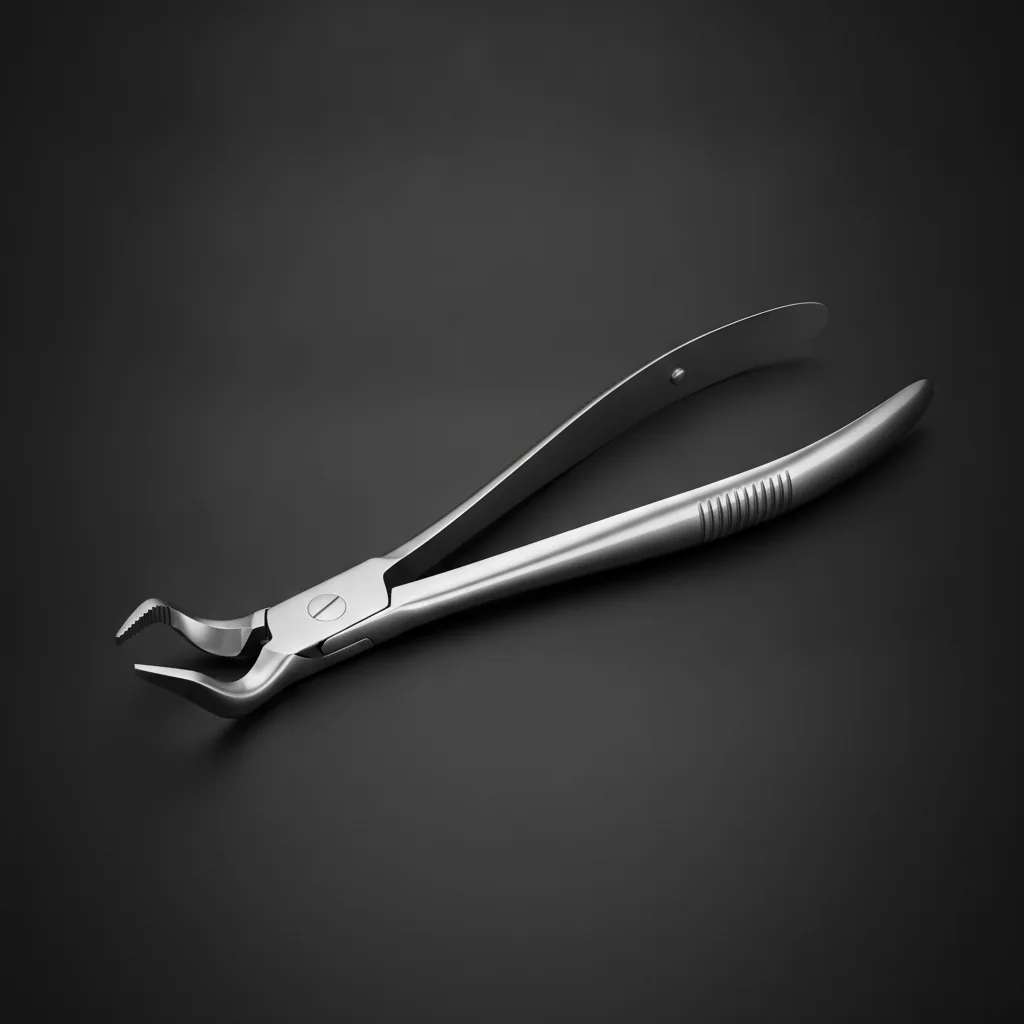
Dental Extraction Forceps — Pattern and Clinical Use
Extraction forceps grip the root of the tooth, not the crown. The beaks are shaped to match the root anatomy of a specific tooth and are seated apically under the gingival margin, so force is applied to the root itself. Because upper and lower teeth and each tooth type have different root forms, forceps are numbered by pattern — using the wrong number risks fracturing the crown instead of delivering the tooth.
Pattern numbering follows established systems, with separate ranges for upper and lower, anterior, premolar, molar and root patterns, plus dedicated paediatric sizes. Beak-to-beak alignment under load is the critical manufacturing tolerance.
Dental Extraction Forceps Variants and Specifications
Common extraction-forceps patterns by application.
| Pattern | Application |
|---|---|
| Upper anterior / universal | Upper incisors and canines |
| Upper premolar | Upper bicuspids |
| Upper molar left / right | Beak matched to buccal root |
| Lower universal | Lower anteriors and premolars |
| Lower molar (cowhorn) | Engages the bifurcation |
| Root / residual root patterns | Fine beaks for retained roots |
| Paediatric range | Scaled for deciduous teeth |
Material, Finish and Quality Control
We forge dental Extraction forceps from AISI 420 martensitic stainless. Beak alignment is checked under closing load, since beaks that twist or gape under force will crush the crown instead of gripping the root. Each batch passes Rockwell hardness testing, dimensional checks on beak alignment under load, and visual inspection under our ISO 13485 system before passivation and final finishing. Mirror and satin finishes are both available — satin is usually specified where glare under operating lights is a concern.
Who Sources Dental Extraction Forceps From Surgical Star
Extraction forceps are a high-value dental line sold as numbered ranges to dental and oral-surgery distributors. Full pattern coverage is a competitive advantage because practices order by number.
OEM, Certification and Ordering
Every dental Extraction forceps can be produced as a private-label line: your logo laser-marked on the handle, your catalog numbers, and your own printed packaging, manufactured from your drawings or a reference sample. Manufactured under an ISO 13485 quality system, CE-marked to EU MDR 2017/745 and covered by US FDA establishment registration. A certificate of conformity and an ASTM F899 material certificate for the exact steel grade ship with your order.
MOQs are low and new-brand friendly, and vary with pattern, finish and branding. Pricing is direct from the factory and tiered by volume. After you approve a branded pre-production sample, bulk production typically runs four to six weeks and ships worldwide DDP with HS codes handled. See how OEM & private label works →
Related Dental Instruments
Frequently Asked Questions
Why are extraction forceps numbered?
Because each pattern’s beaks are shaped for the root anatomy of a specific tooth. Using the wrong number means the beaks cannot seat on the root and the crown may fracture.
What is a cowhorn forceps?
A lower molar pattern whose pointed beaks engage the bifurcation between the roots, using the tooth’s own anatomy to deliver it.
Do you supply paediatric extraction forceps?
Yes, as a scaled range for deciduous teeth. Paediatric patterns are a common gap in competitor catalogs and worth stocking as a differentiator.
Can you manufacture these under our own brand?
Yes — full OEM and private label. We laser-mark your logo and catalog numbers, pack in your branded boxes, and work from your drawings, tech pack or a reference sample, with a pre-production sample approved before any bulk run.
Send your pattern list, drawing or a reference sample and we’ll quote MOQ, pricing and lead time — standard catalog or fully private-label.
Request a Free Quote Order a Sample