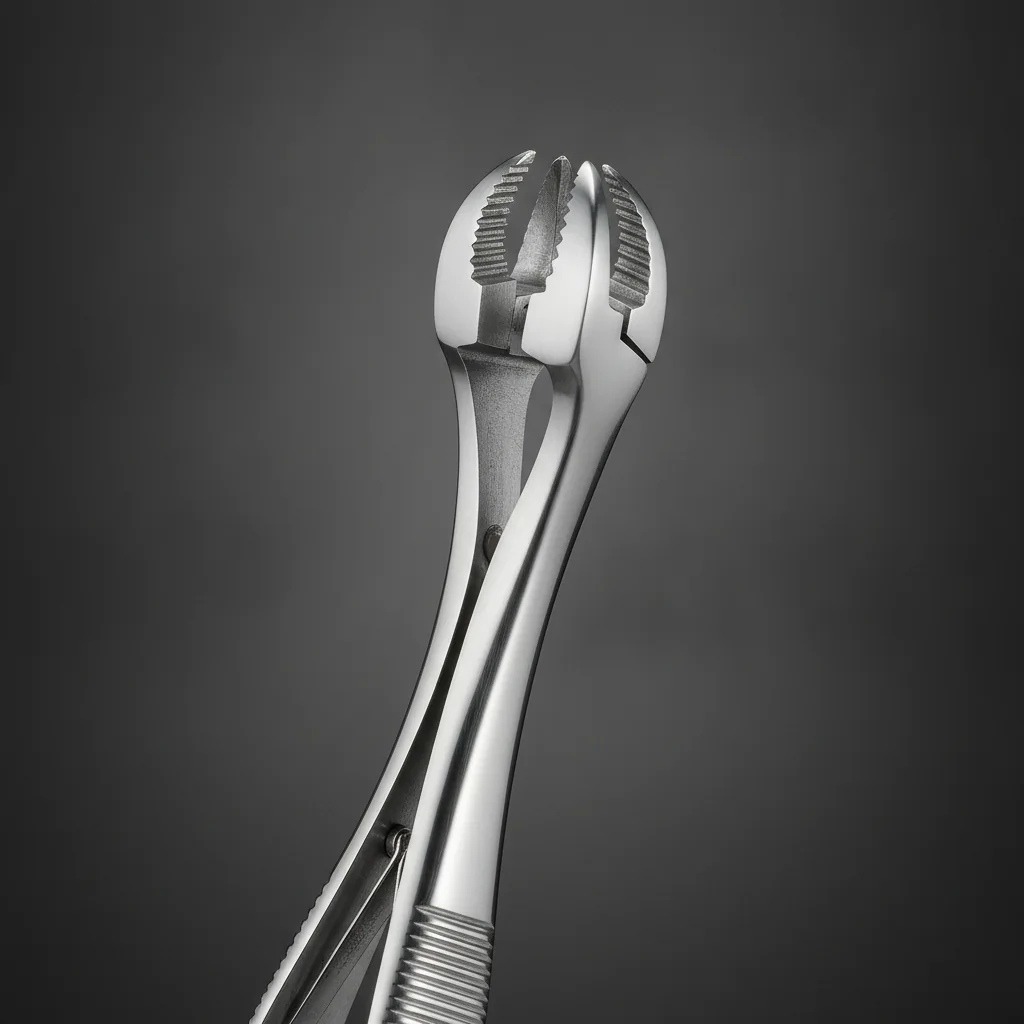
Bone Rongeurs — Pattern and Clinical Use
A rongeur removes bone where a saw or osteotome would be too crude — trimming a fracture edge, nibbling back a bony margin, or clearing osteophytes. The cupped jaws shear a defined bite and the internal spring reopens them, so the surgeon works in repeated controlled increments. Single-action patterns give fine control; double-action patterns multiply the mechanical advantage for dense cortical bone.
Cutting edges must shear rather than crush, because crushed bone leaves a ragged margin and bone dust. Jaw hardness is the limiting factor on service life, since edges work directly against cortical bone.
Bone Rongeurs Variants and Specifications
Standard bone rongeur patterns.
| Pattern | Specification / use |
|---|---|
| Luer, single action | General bone nibbling |
| Stille-Luer, double action | Dense cortical bone |
| Beyer, curved jaw | Working around contours |
| Friedman, fine jaw | Small bone and fine trimming |
| Straight or curved jaw | Approach preference |
| Tungsten-carbide edge | Extended cutting life |
Material, Finish and Quality Control
We forge bone rongeurs from AISI 420 martensitic stainless. Jaw edges are hardness-tested and checked for clean shearing, and the spring is cycle-tested to confirm reliable jaw return. Each batch passes Rockwell hardness testing, dimensional checks on edge hardness and spring return, and visual inspection under our ISO 13485 system before passivation and final finishing. Mirror and satin finishes are both available — satin is usually specified where glare under operating lights is a concern.
Who Sources Bone Rongeurs From Surgical Star
Bone rongeurs are a core orthopedic line ordered across several jaw shapes and actions, and sell to hospital orthopedic distributors and spinal surgery suppliers.
OEM, Certification and Ordering
Every bone rongeurs can be produced as a private-label line: your logo laser-marked on the shank, your catalog numbers, and your own printed packaging, manufactured from your drawings or a reference sample. Our quality file is ISO 13485, our EU route is CE marking under MDR 2017/745, and our facility holds US FDA establishment registration. Conformity and ASTM F899 material certificates are issued against each order.
You order direct from the factory with no trading-house margin, on volume-tiered pricing and a minimum matched to your pattern and finish. Once your branded sample is signed off, expect roughly four to six weeks to bulk delivery, worldwide DDP. See how OEM & private label works →
Related Orthopedic Instruments
Frequently Asked Questions
What is the difference between single and double action?
Double-action rongeurs have an extra linkage that multiplies mechanical advantage, making them suited to dense cortical bone. Single-action patterns give finer control on softer bone.
Why must the jaws shear rather than crush?
Crushed bone leaves a ragged margin and generates bone dust. A clean shear gives a sound edge, which matters where the bone will be fixed or grafted.
What limits rongeur service life?
Jaw edge hardness, since the edges work directly against cortical bone. Carbide-edged versions last considerably longer.
Can you manufacture these under our own brand?
Yes — full OEM and private label. We laser-mark your logo and catalog numbers, pack in your branded boxes, and work from your drawings, tech pack or a reference sample, with a pre-production sample approved before any bulk run.
Send your pattern list, drawing or a reference sample and we’ll quote MOQ, pricing and lead time — standard catalog or fully private-label.
Request a Free Quote Order a Sample