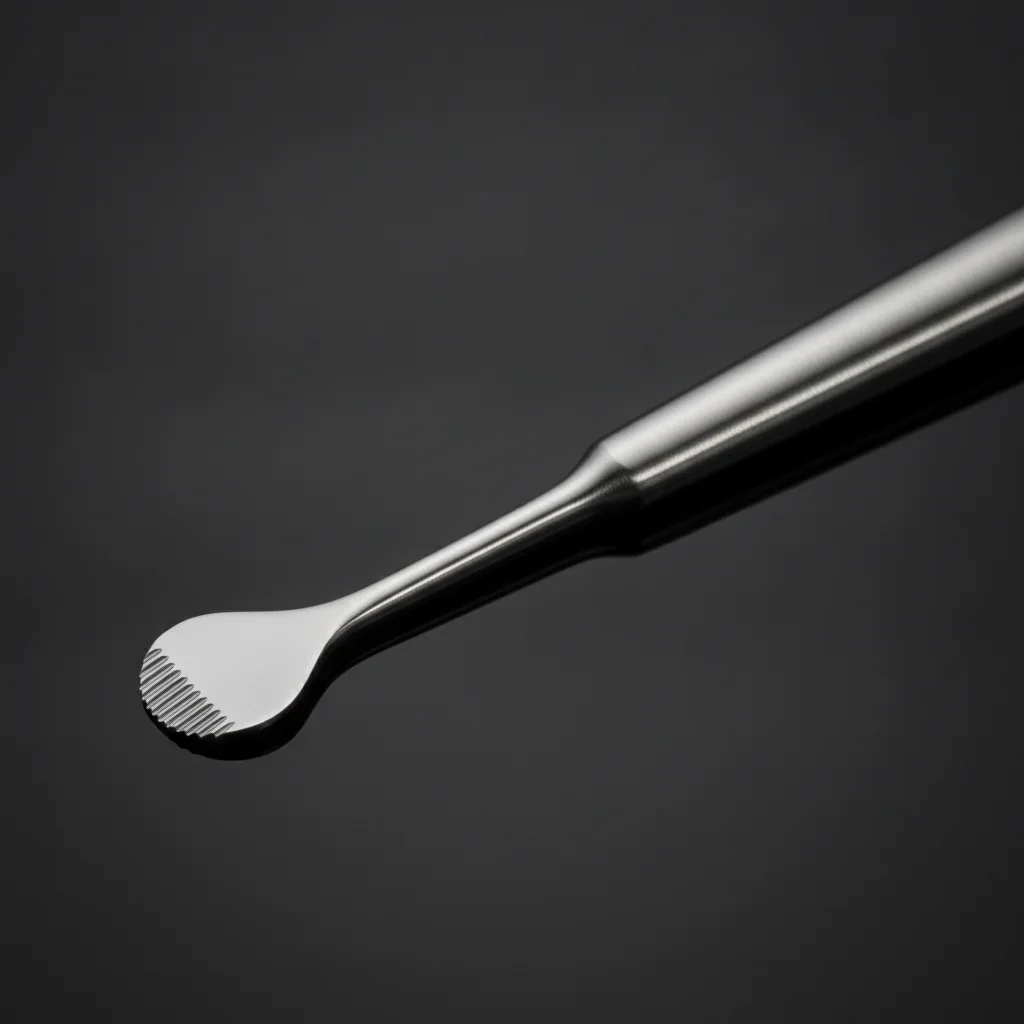
Podiatry Curettes — Pattern and Clinical Use
A corn has a central keratotic core that must be removed to relieve pressure, and a curette lifts that core out cleanly. The sharpened ring is worked around the lesion and beneath the core, separating it from surrounding tissue at its natural margin. Compared with paring the lesion flat with a blade, curettage removes the core specifically rather than just reducing bulk.
Ring size is chosen for lesion size, and sharpness must be consistent around the whole circumference since the curette works in every direction around a corn. Double-ended patterns give two sizes in one instrument.
Podiatry Curettes Variants and Specifications
Standard podiatry curette patterns.
| Variant | Specification / use |
|---|---|
| 2–3 mm ring | Small corns and seed lesions |
| 4–5 mm ring | General corn enucleation |
| 6–7 mm ring | Larger callus cores |
| Double-ended | Two ring sizes per instrument |
| Angled ring | Access to interdigital lesions |
| Spoon pattern | Broader debridement |
Material, Finish and Quality Control
We forge Podiatry curettes from AISI 420 martensitic stainless. Ring edges are inspected for even sharpness around the full circumference, since the curette works in every direction around a lesion. Each batch passes Rockwell hardness testing, dimensional checks on ring edge sharpness all round, and visual inspection under our ISO 13485 system before passivation and final finishing. Mirror and satin finishes are both available — satin is usually specified where glare under operating lights is a concern.
Who Sources Podiatry Curettes From Surgical Star
Podiatry curettes sell in volume to podiatry and chiropody distributors and are used at almost every routine treatment appointment.
OEM, Certification and Ordering
Every Podiatry curettes can be produced as a private-label line: your logo laser-marked on the handle, your catalog numbers, and your own printed packaging, manufactured from your drawings or a reference sample. Our quality file is ISO 13485, our EU route is CE marking under MDR 2017/745, and our facility holds US FDA establishment registration. Conformity and ASTM F899 material certificates are issued against each order.
You order direct from the factory with no trading-house margin, on volume-tiered pricing and a minimum matched to your pattern and finish. Once your branded sample is signed off, expect roughly four to six weeks to bulk delivery, worldwide DDP. See how OEM & private label works →
Related Podiatry Instruments
Frequently Asked Questions
Why curette a corn rather than pare it?
Curettage removes the keratotic core specifically, relieving the pressure point. Paring only reduces bulk and leaves the core in place.
What ring size should we stock?
A graduated range from about 2 mm to 7 mm, since corn and callus core size varies considerably.
Are angled versions useful?
Yes, particularly for interdigital lesions where a straight instrument cannot be positioned between the toes.
Can you manufacture these under our own brand?
Yes — full OEM and private label. We laser-mark your logo and catalog numbers, pack in your branded boxes, and work from your drawings, tech pack or a reference sample, with a pre-production sample approved before any bulk run.
Send your pattern list, drawing or a reference sample and we’ll quote MOQ, pricing and lead time — standard catalog or fully private-label.
Request a Free Quote Order a Sample