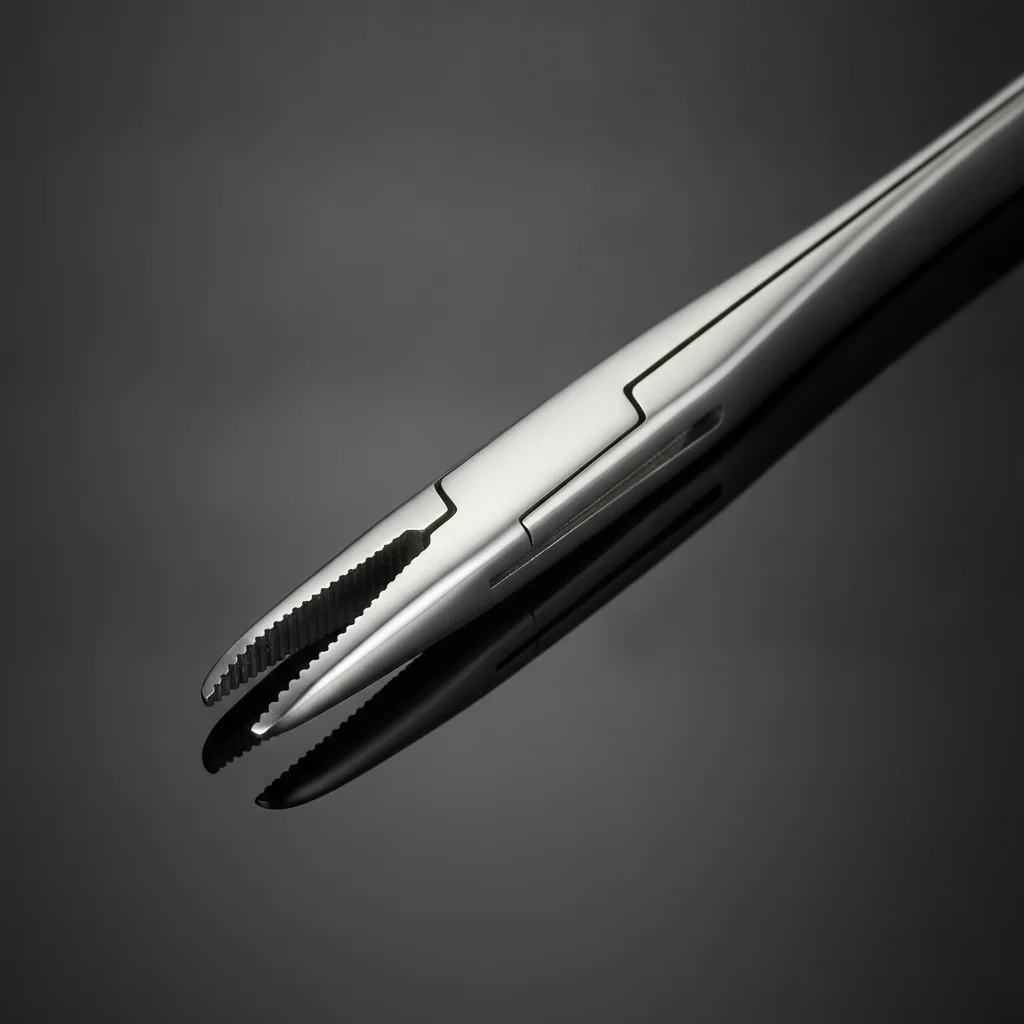
Needle Holders — Pattern and Clinical Use
A needle holder must hold the needle at a fixed angle without letting it rotate, and release it cleanly when the ratchet is opened. That is harder than it sounds: the jaw has to grip a hardened needle without crushing it or being scored by it, which is why serious patterns use tungsten-carbide inserts. Pattern choice follows the work — Mayo-Hegar for general suturing, Crile-Wood for finer work, Webster and Derf for fine and ophthalmic-adjacent use, Mathieu for a ratchet in the palm.
Tungsten-carbide-inserted holders are identified by gold-coloured rings. The carbide face is what stops the jaw wearing smooth against the needle; a worn plain-stainless jaw lets the needle spin, which is the most common reason these are retired.
Needle Holders Variants and Specifications
The needle-holder patterns we tool. All are available with or without tungsten-carbide inserts.
| Pattern | Specification / use |
|---|---|
| Mayo-Hegar | General suturing; ring handles, box lock |
| Olsen-Hegar | Combined needle holder and suture scissor |
| Crile-Wood | Finer jaw for smaller needles |
| Webster | Short, fine; plastic and delicate work |
| Derf | Short pattern, common in dental and minor surgery |
| Mathieu | Palm-held with curved ratchet handle |
Material, Finish and Quality Control
We forge needle holders from AISI 420 stainless with tungsten-carbide inserts. Jaw faces are checked for cross-serration integrity and the ratchet tested through every tooth, since a needle holder that slips at one ratchet position is unusable. Each batch passes Rockwell hardness testing, dimensional checks on jaw face and ratchet at every tooth, and visual inspection under our ISO 13485 system before passivation and final finishing. Mirror and satin finishes are both available — satin is usually specified where glare under operating lights is a concern.
Who Sources Needle Holders From Surgical Star
Needle holders are a core line for every surgical catalog and a standard component of suture kits, so they sell across general, dental, veterinary and plastic-surgery ranges. Carbide versions carry a higher margin and are worth listing as separate catalog numbers.
OEM, Certification and Ordering
Every needle holders can be produced as a private-label line: your logo laser-marked on the shank, your catalog numbers, and your own printed packaging, manufactured from your drawings or a reference sample. Our quality file is ISO 13485, our EU route is CE marking under MDR 2017/745, and our facility holds US FDA establishment registration. Conformity and ASTM F899 material certificates are issued against each order.
You order direct from the factory with no trading-house margin, on volume-tiered pricing and a minimum matched to your pattern and finish. Once your branded sample is signed off, expect roughly four to six weeks to bulk delivery, worldwide DDP. See how OEM & private label works →
Related General Surgery Instruments
Frequently Asked Questions
What do the gold rings on a needle holder mean?
Gold-coloured handles or rings indicate tungsten-carbide inserts in the jaws. Carbide resists wear from the hardened needle far better than plain stainless and gives a much longer service life.
Which needle holder pattern should we stock first?
Mayo-Hegar is the general-purpose default and the highest-volume pattern in most catalogs. Crile-Wood and Webster follow for finer work.
Why do needle holders wear out?
The hardened suture needle gradually polishes the jaw serrations smooth, after which the needle rotates in the jaw. Tungsten-carbide inserts delay this substantially.
Can you manufacture these under our own brand?
Yes — full OEM and private label. We laser-mark your logo and catalog numbers, pack in your branded boxes, and work from your drawings, tech pack or a reference sample, with a pre-production sample approved before any bulk run.
Send your pattern list, drawing or a reference sample and we’ll quote MOQ, pricing and lead time — standard catalog or fully private-label.
Request a Free Quote Order a Sample