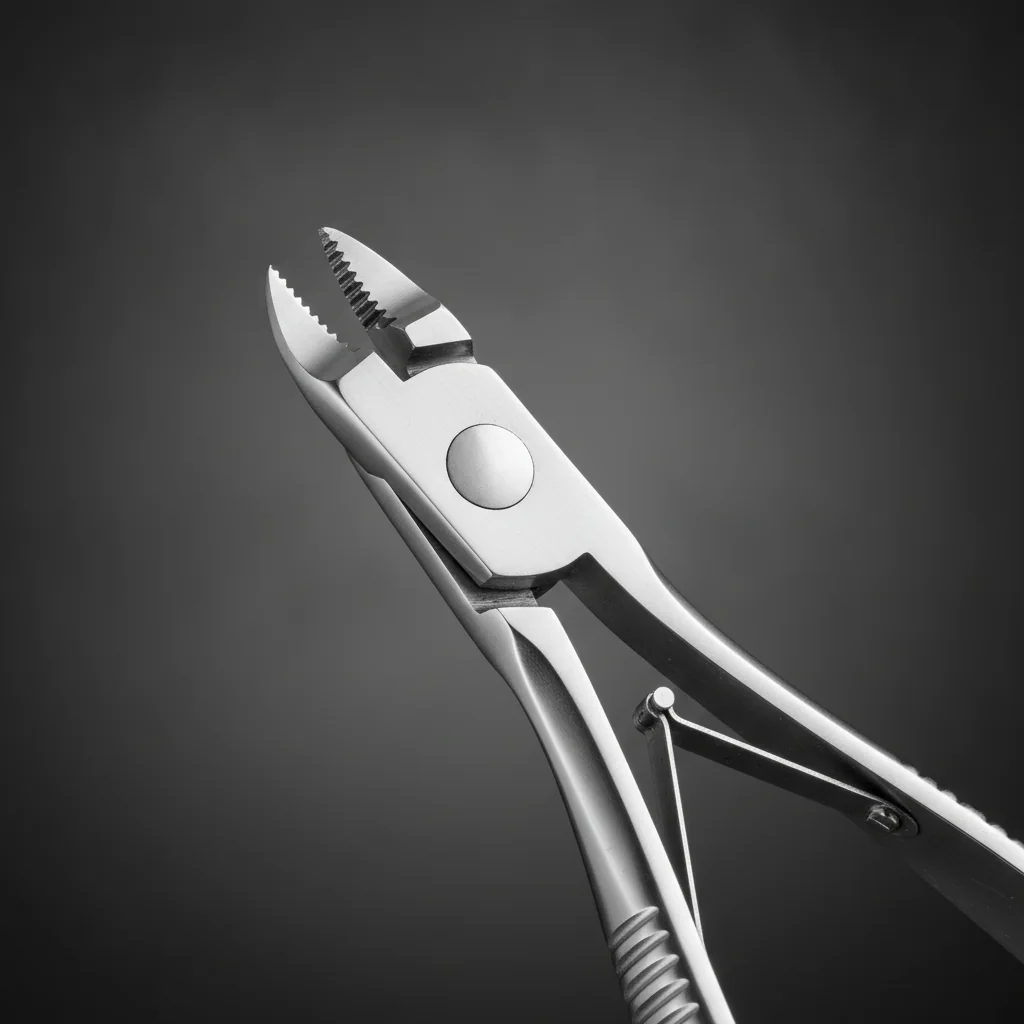
Distal End Cutters — Pattern and Clinical Use
When an archwire is engaged it protrudes behind the last molar tube, where a projecting end would lacerate the cheek. The distal end cutter trims it flush intraorally — and critically, its safety hold grips the severed fragment so it is not dropped into the patient’s airway. That retention feature is the reason the instrument exists in this specific form rather than as an ordinary cutter.
Blades must cut hardened stainless and nickel-titanium archwire up to around 0.021 x 0.025in without chipping, which is a far heavier duty than a ligature cutter faces. Most practices treat these as a premium instrument and buy carbide.
Distal End Cutters Variants and Specifications
Standard distal end cutter patterns.
| Variant | Specification / use |
|---|---|
| Standard safety hold | Retains the cut archwire fragment |
| Mini / slim head | Confined posterior access |
| Angled head | Improved distal reach |
| Cuts to 0.021 x 0.025in | Full working archwire range |
| Tungsten-carbide inserts | Essential for hardened archwire |
| Long handle | Increased leverage on heavy wire |
Material, Finish and Quality Control
We forge distal end cutters from AISI 420 stainless with tungsten-carbide inserts. Cutting edges are tested on hardened archwire stock and the safety-hold mechanism verified to retain the fragment every time. Each batch passes Rockwell hardness testing, dimensional checks on edge integrity on hardened wire and fragment retention, and visual inspection under our ISO 13485 system before passivation and final finishing. Mirror and satin finishes are both available — satin is usually specified where glare under operating lights is a concern.
Who Sources Distal End Cutters From Surgical Star
Distal end cutters are the single highest-value hand instrument in most orthodontic catalogs and are replaced regularly as edges degrade, giving strong repeat revenue for distributors.
OEM, Certification and Ordering
Every distal end cutters can be produced as a private-label line: your logo laser-marked on the handle, your catalog numbers, and your own printed packaging, manufactured from your drawings or a reference sample. Production runs inside a documented ISO 13485 quality system, with CE marking under EU MDR 2017/745 and US FDA establishment registration behind it. Your shipment carries a certificate of conformity plus the ASTM F899 material certificate for the grade actually used.
Minimums stay deliberately low so a new brand can launch without a heavy first order, and pricing is quoted direct from the factory on volume tiers. Bulk production usually takes four to six weeks from sample approval, shipped DDP with export paperwork and HS codes handled. See how OEM & private label works →
Related Orthodontic Instruments
Frequently Asked Questions
Why does a distal end cutter hold the cut piece?
So the severed archwire fragment cannot be dropped into the patient’s mouth or airway. The safety hold is a patient-safety feature, not a convenience.
What wire size can it cut?
Standard patterns cut hardened stainless and nickel-titanium archwire up to around 0.021 x 0.025in. Cutting beyond the rated size chips the blades.
Should we stock carbide versions only?
Most practices prefer carbide because hardened archwire is punishing on plain stainless edges. Carrying both lets price-sensitive buyers choose.
Can you manufacture these under our own brand?
Yes — full OEM and private label. We laser-mark your logo and catalog numbers, pack in your branded boxes, and work from your drawings, tech pack or a reference sample, with a pre-production sample approved before any bulk run.
Send your pattern list, drawing or a reference sample and we’ll quote MOQ, pricing and lead time — standard catalog or fully private-label.
Request a Free Quote Order a Sample