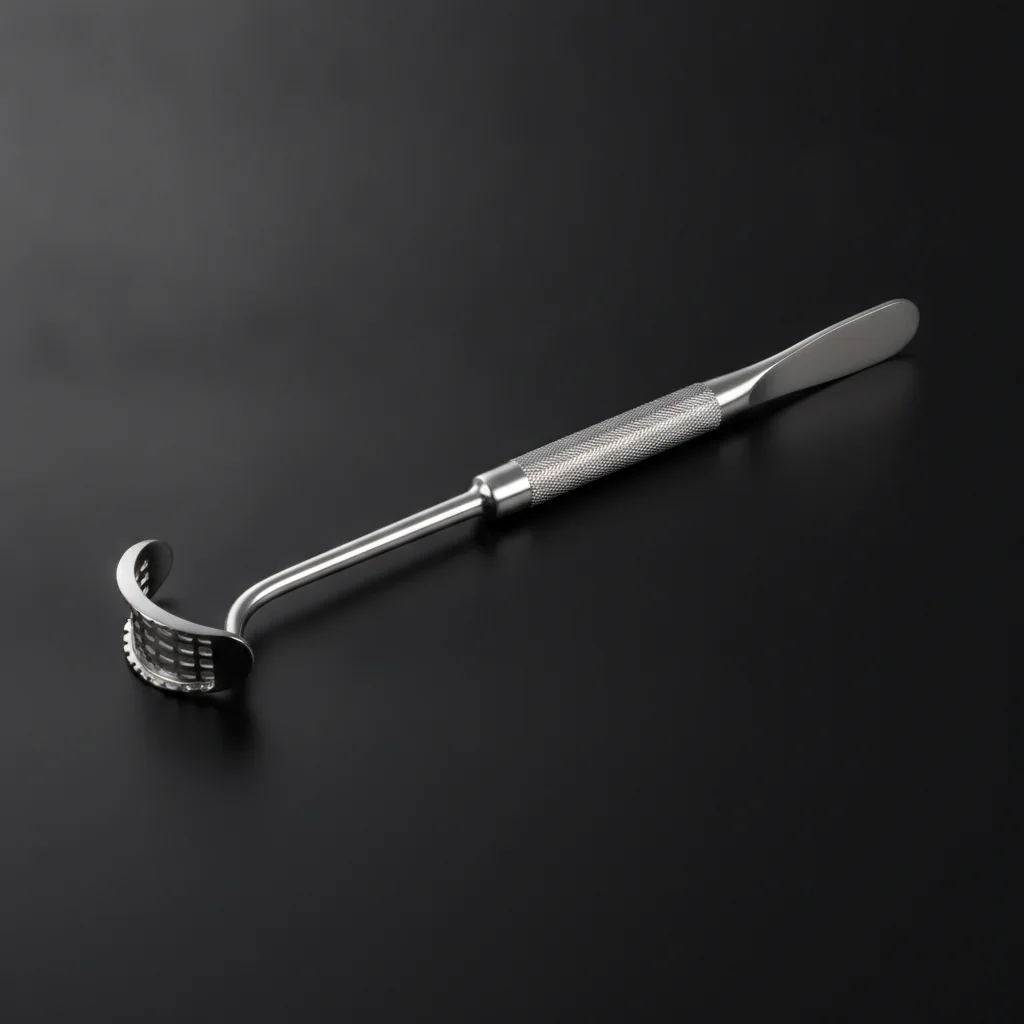
Adenoid Curettes — Pattern and Clinical Use
The curette is passed behind the soft palate into the nasopharynx and drawn downward, shaving the adenoid pad from the posterior wall in one controlled sweep. Because the procedure is performed largely by feel rather than direct vision, blade size and cage design determine how completely the tissue is removed and whether surrounding structures are protected.
The St Clair Thomson pattern carries a cage that captures the excised tissue, preventing it falling into the airway — a meaningful safety feature given the working conditions. Blade sharpness must be consistent because a dull curette tears rather than cuts.
Adenoid Curettes Variants and Specifications
Standard adenoid curette patterns and sizes.
| Variant | Specification / use |
|---|---|
| St Clair Thomson, caged | Captures excised tissue |
| Beckmann pattern | Uncaged, adjustable blade |
| Sizes 0–4 | Graduated blade widths by patient age |
| Sharp guarded blade | Controlled single-sweep resection |
| Detachable cage | Strips for reprocessing |
| Satin finish | Reduces glare |
Material, Finish and Quality Control
We forge Adenoid curettes from AISI 420 martensitic stainless. Blade edge keenness is verified across the full cutting width, since a dull curette tears adenoid tissue rather than shaving it cleanly. Each batch passes Rockwell hardness testing, dimensional checks on edge keenness across cutting width, and visual inspection under our ISO 13485 system before passivation and final finishing. Mirror and satin finishes are both available — satin is usually specified where glare under operating lights is a concern.
Who Sources Adenoid Curettes From Surgical Star
Adenoid curettes sell to ENT surgical distributors as graduated size sets, and are standard in paediatric ENT theatre trays alongside mouth gags.
OEM, Certification and Ordering
Every Adenoid curettes can be produced as a private-label line: your logo laser-marked on the shaft, your catalog numbers, and your own printed packaging, manufactured from your drawings or a reference sample. Manufactured under an ISO 13485 quality system, CE-marked to EU MDR 2017/745 and covered by US FDA establishment registration. A certificate of conformity and an ASTM F899 material certificate for the exact steel grade ship with your order.
MOQs are low and new-brand friendly, and vary with pattern, finish and branding. Pricing is direct from the factory and tiered by volume. After you approve a branded pre-production sample, bulk production typically runs four to six weeks and ships worldwide DDP with HS codes handled. See how OEM & private label works →
Related ENT Instruments
Frequently Asked Questions
What does the cage on a St Clair Thomson curette do?
It captures the excised adenoid tissue so it cannot fall into the airway — an important safety feature in a procedure performed largely by feel.
What sizes are needed?
A graduated set, commonly sizes 0 to 4, so blade width can be matched to the patient’s age and nasopharyngeal dimensions.
Why must the blade be sharp?
A dull curette tears the tissue rather than shaving it cleanly, which increases bleeding and leaves an irregular resection.
Can you manufacture these under our own brand?
Yes — full OEM and private label. We laser-mark your logo and catalog numbers, pack in your branded boxes, and work from your drawings, tech pack or a reference sample, with a pre-production sample approved before any bulk run.
Send your pattern list, drawing or a reference sample and we’ll quote MOQ, pricing and lead time — standard catalog or fully private-label.
Request a Free Quote Order a Sample