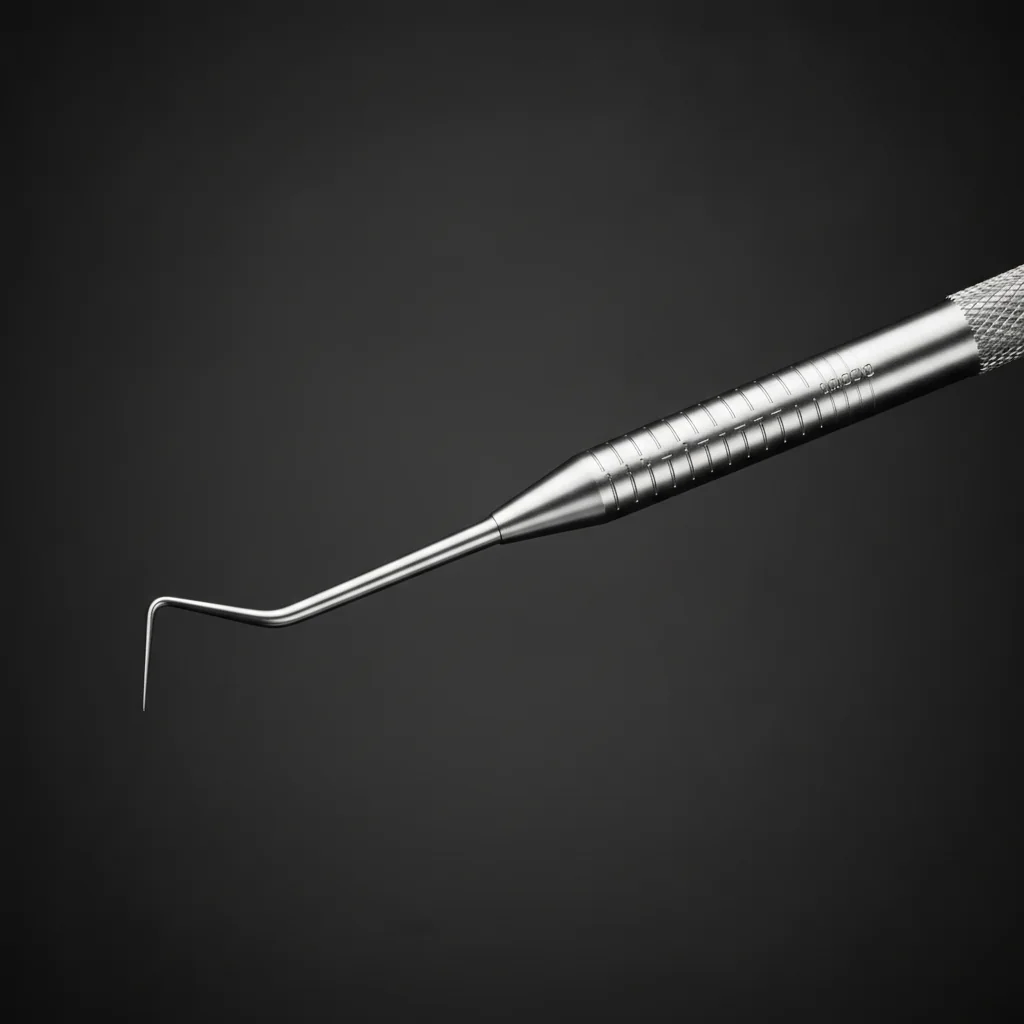
Periodontal Probes — Pattern and Clinical Use
The probe is a measuring instrument, not a cutting one. It is walked around each tooth and the graduations read against the gingival margin to record pocket depth in millimetres, building the chart that periodontal diagnosis depends on. Because the reading is the clinical output, the accuracy and legibility of the markings are the entire value of the instrument.
Marking systems differ and are not interchangeable: the Williams probe is marked 1-2-3-5-7-8-9-10, the UNC-15 is marked every millimetre to 15 with bands, and the WHO/CPITN probe carries a ball tip and a coloured band for screening. A practice must standardise on one system.
Periodontal Probes Variants and Specifications
Standard probe marking systems.
| Pattern | Graduation / use |
|---|---|
| Williams | 1-2-3-5-7-8-9-10 mm markings |
| UNC-15 | Every mm to 15, banded at 5, 10, 15 |
| WHO / CPITN | Ball tip with coloured band for screening |
| Nabers (2N) | Curved, for furcation involvement |
| Colour-coded markings | Improved legibility against tissue |
| Double-ended with explorer | Combined diagnostic instrument |
Material, Finish and Quality Control
We forge periodontal probes from 316L austenitic stainless. Graduation position and depth of marking are gauged against a reference, since the measurement is the clinical output of the instrument. Each batch passes Rockwell hardness testing, dimensional checks on graduation accuracy against reference, and visual inspection under our ISO 13485 system before passivation and final finishing. Mirror and satin finishes are both available — satin is usually specified where glare under operating lights is a concern.
Who Sources Periodontal Probes From Surgical Star
Periodontal probes sell to dental and hygiene distributors and are usually ordered by marking system, since a practice standardises on one. Colour-coded versions command a premium and are increasingly the default.
OEM, Certification and Ordering
Every periodontal probes can be produced as a private-label line: your logo laser-marked on the handle, your catalog numbers, and your own printed packaging, manufactured from your drawings or a reference sample. Our quality file is ISO 13485, our EU route is CE marking under MDR 2017/745, and our facility holds US FDA establishment registration. Conformity and ASTM F899 material certificates are issued against each order.
You order direct from the factory with no trading-house margin, on volume-tiered pricing and a minimum matched to your pattern and finish. Once your branded sample is signed off, expect roughly four to six weeks to bulk delivery, worldwide DDP. See how OEM & private label works →
Related Dental Instruments
Frequently Asked Questions
What is the difference between Williams and UNC-15 probes?
The marking pattern. Williams probes are marked 1-2-3-5-7-8-9-10 mm; UNC-15 probes are marked every millimetre to 15 with bands at 5, 10 and 15. Practices standardise on one system.
What is a WHO probe used for?
Periodontal screening. It has a ball tip and a coloured band, and is used for basic periodontal examination scoring rather than detailed pocket charting.
Are colour-coded probes better?
They are easier to read against tissue, which reduces charting error. They now account for a large share of orders, though plain-etched versions remain available.
Can you manufacture these under our own brand?
Yes — full OEM and private label. We laser-mark your logo and catalog numbers, pack in your branded boxes, and work from your drawings, tech pack or a reference sample, with a pre-production sample approved before any bulk run.
Send your pattern list, drawing or a reference sample and we’ll quote MOQ, pricing and lead time — standard catalog or fully private-label.
Request a Free Quote Order a Sample