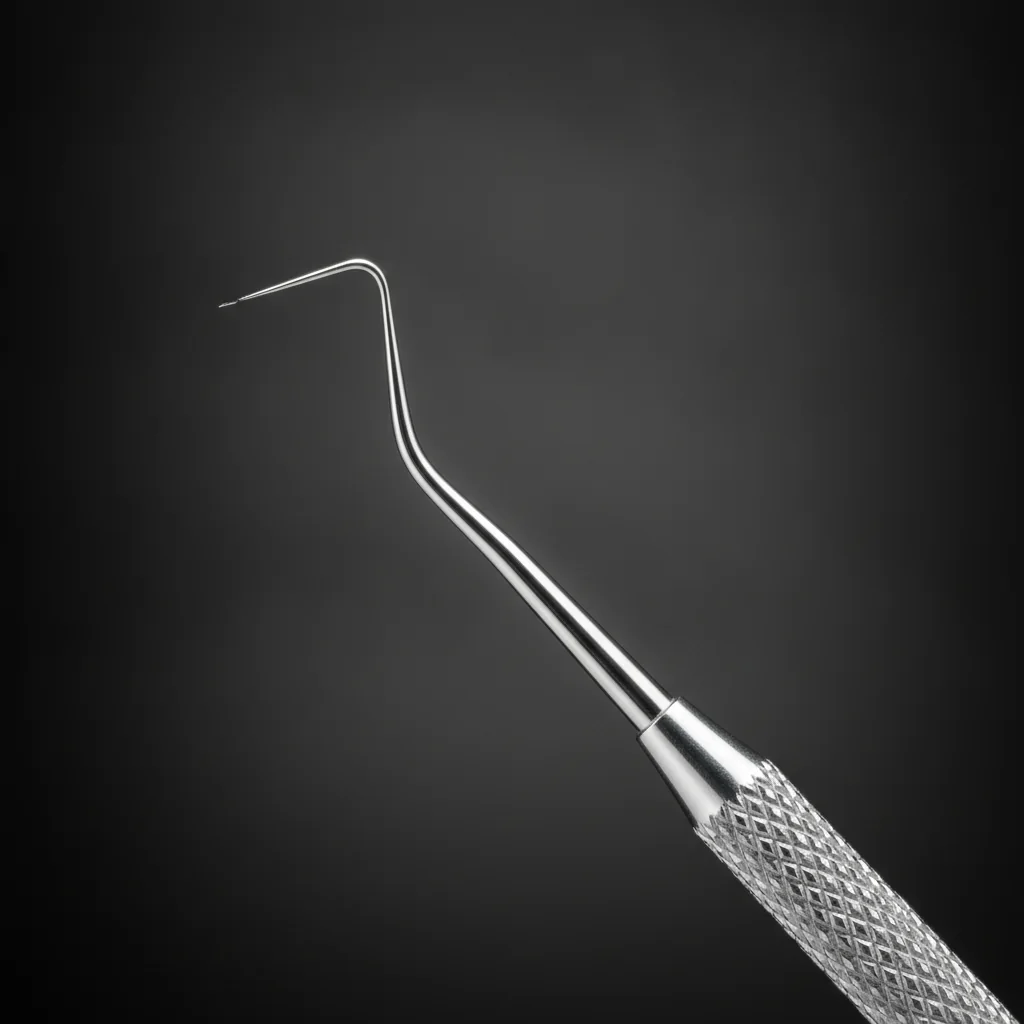
Dental Scalers — Pattern and Clinical Use
A scaler removes hard deposit above the gum line. The working end is a pointed blade with two cutting edges brought to a sharp tip, which lets it reach into the interproximal spaces where calculus accumulates. Because the tip is pointed, scalers are used supragingivally — below the gum line a curette with a rounded toe is used instead, to avoid lacerating the pocket lining.
Scalers are resharpened repeatedly through their working life, so the steel must take and hold a fine edge through many sharpening cycles. That is a different requirement from an instrument that is simply used until blunt and replaced.
Dental Scalers Variants and Specifications
Standard scaler patterns.
| Pattern | Typical use |
|---|---|
| Sickle, straight | Anterior supragingival calculus |
| Sickle, curved | Posterior interproximal access |
| Jacquette | Fine supragingival scaling |
| H6/H7 | General-purpose scaling |
| Double-ended | Paired working ends on one handle |
| Hollow lightweight handle | Reduces hand fatigue, improves tactile feel |
Material, Finish and Quality Control
We forge dental scalers from AISI 420 martensitic stainless. Edge geometry is set so the blade takes a true edge on resharpening, since these instruments are sharpened repeatedly through service rather than replaced when dull. Each batch passes Rockwell hardness testing, dimensional checks on edge geometry and hardness for resharpening, and visual inspection under our ISO 13485 system before passivation and final finishing. Mirror and satin finishes are both available — satin is usually specified where glare under operating lights is a concern.
Who Sources Dental Scalers From Surgical Star
Scalers are core stock for dental and hygiene distributors and sell in high volume, usually as double-ended patterns. Handle weight and grip texture are significant purchasing factors for hygienists.
OEM, Certification and Ordering
Every dental scalers can be produced as a private-label line: your logo laser-marked on the handle, your catalog numbers, and your own printed packaging, manufactured from your drawings or a reference sample. Manufactured under an ISO 13485 quality system, CE-marked to EU MDR 2017/745 and covered by US FDA establishment registration. A certificate of conformity and an ASTM F899 material certificate for the exact steel grade ship with your order.
MOQs are low and new-brand friendly, and vary with pattern, finish and branding. Pricing is direct from the factory and tiered by volume. After you approve a branded pre-production sample, bulk production typically runs four to six weeks and ships worldwide DDP with HS codes handled. See how OEM & private label works →
Related Dental Instruments
Frequently Asked Questions
What is the difference between a scaler and a curette?
A scaler has a pointed tip and is used above the gum line. A curette has a rounded toe and is designed to work subgingivally without lacerating the pocket lining.
Can scalers be resharpened?
Yes, and they are designed for it. The steel is specified to take a true edge through many sharpening cycles rather than being replaced when dull.
Why do hygienists prefer hollow handles?
They are lighter, which reduces hand fatigue over a full day of scaling, and the larger diameter improves tactile feedback and grip.
Can you manufacture these under our own brand?
Yes — full OEM and private label. We laser-mark your logo and catalog numbers, pack in your branded boxes, and work from your drawings, tech pack or a reference sample, with a pre-production sample approved before any bulk run.
Send your pattern list, drawing or a reference sample and we’ll quote MOQ, pricing and lead time — standard catalog or fully private-label.
Request a Free Quote Order a Sample