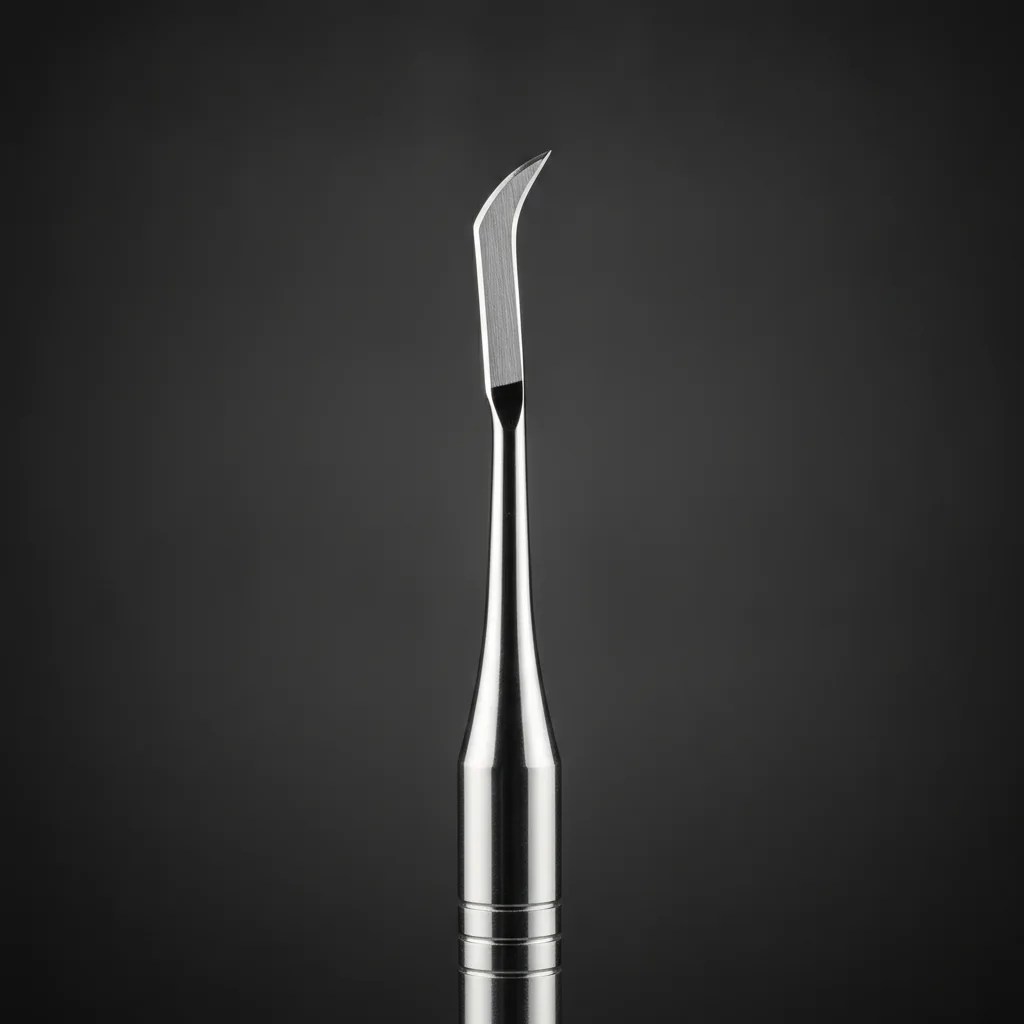
Luxators — Pattern and Clinical Use
A luxator cuts rather than levers. Its blade is thinner and sharper than an elevator’s and is advanced apically into the periodontal ligament space with gentle pressure, severing the fibres and compressing the alveolar bone slightly. That mechanism preserves surrounding bone better than aggressive levering, which is why luxators are favoured where an implant is planned in the same site.
Because the blade is thin and used with apical pressure, blade temper is a genuine safety characteristic. A blade that snaps under load in the periodontal space is a serious clinical problem, so hardness must be balanced against toughness.
Luxators Variants and Specifications
Standard luxator patterns.
| Variant | Specification / use |
|---|---|
| 3 mm straight | Anterior and narrow spaces |
| 5 mm straight | General luxation |
| 3 mm / 5 mm curved | Posterior access |
| Bayonet pattern | Improved posterior reach |
| Fine tapered blade | Enters the PDL space cleanly |
| Colour-coded handles | Rapid identification in the tray |
Material, Finish and Quality Control
We forge luxators from AISI 420 martensitic stainless. Blade temper is balanced for hardness against toughness and verified by batch testing, because a thin blade that snaps in the periodontal space is a clinical hazard. Each batch passes Rockwell hardness testing, dimensional checks on blade temper — hardness vs toughness, and visual inspection under our ISO 13485 system before passivation and final finishing. Mirror and satin finishes are both available — satin is usually specified where glare under operating lights is a concern.
Who Sources Luxators From Surgical Star
Luxators sell into oral-surgery and implant-focused dental practices, where atraumatic extraction technique is standard. They are a premium line and increasingly requested by implant-placing practices.
OEM, Certification and Ordering
Every luxators can be produced as a private-label line: your logo laser-marked on the handle, your catalog numbers, and your own printed packaging, manufactured from your drawings or a reference sample. Manufactured under an ISO 13485 quality system, CE-marked to EU MDR 2017/745 and covered by US FDA establishment registration. A certificate of conformity and an ASTM F899 material certificate for the exact steel grade ship with your order.
MOQs are low and new-brand friendly, and vary with pattern, finish and branding. Pricing is direct from the factory and tiered by volume. After you approve a branded pre-production sample, bulk production typically runs four to six weeks and ships worldwide DDP with HS codes handled. See how OEM & private label works →
Related Dental Instruments
Frequently Asked Questions
How is a luxator different from an elevator?
A luxator has a thin sharp blade pushed into the periodontal ligament space to sever the fibres. An elevator is thicker and levers against bone to mobilise the tooth.
Why do implant dentists prefer luxators?
Because severing the ligament preserves the surrounding alveolar bone better than aggressive levering, which matters when an implant is planned in the same site.
Can a luxator blade break?
A poorly tempered one can, which is why we balance hardness against toughness and batch-test the temper rather than simply hardening the blade as far as possible.
Can you manufacture these under our own brand?
Yes — full OEM and private label. We laser-mark your logo and catalog numbers, pack in your branded boxes, and work from your drawings, tech pack or a reference sample, with a pre-production sample approved before any bulk run.
Send your pattern list, drawing or a reference sample and we’ll quote MOQ, pricing and lead time — standard catalog or fully private-label.
Request a Free Quote Order a Sample