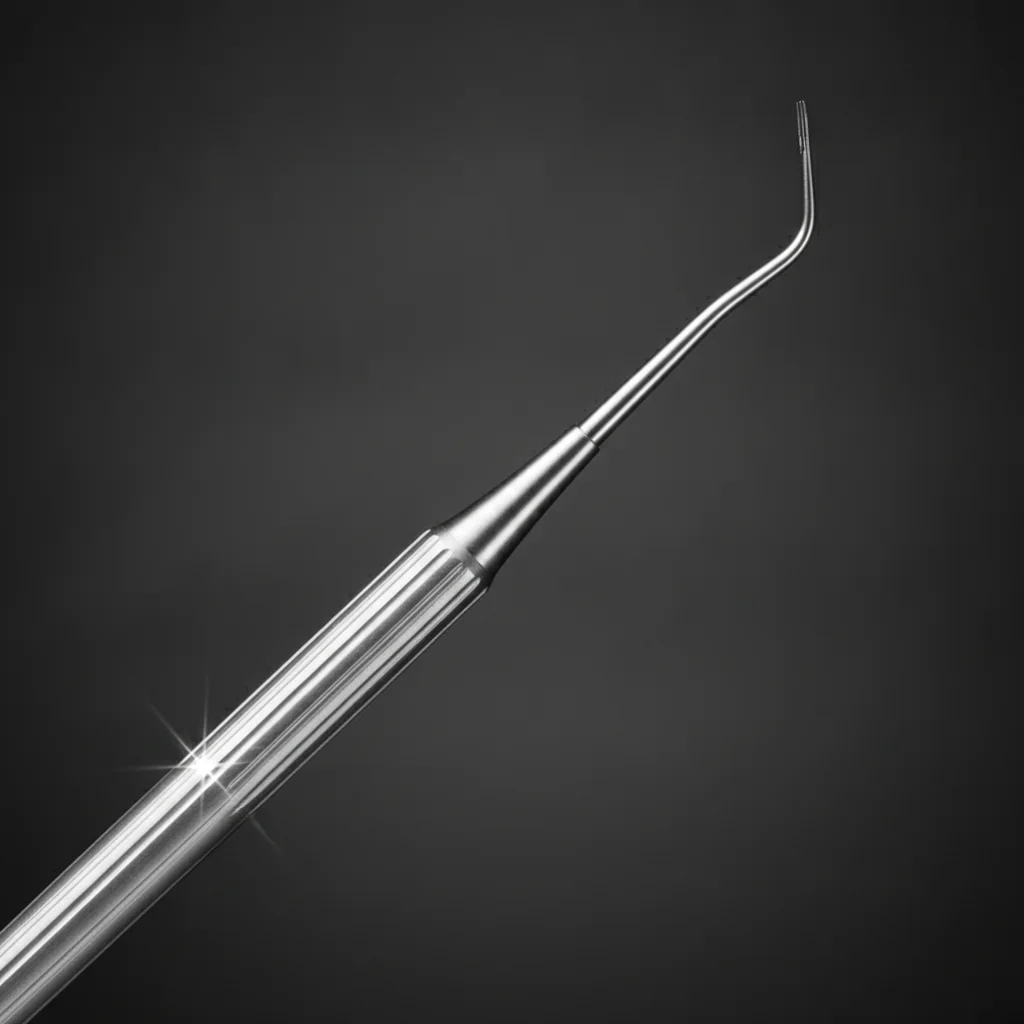
Dental Probes — Pattern and Clinical Use
Dental probes cover the general examination role: checking margins, detecting surface irregularities, exploring fissures and assessing restorations by tactile feedback. Where a periodontal probe is graduated for measurement and an explorer is specifically caries-focused, the general dental probe is the everyday diagnostic instrument, frequently supplied double-ended with two tip geometries.
Double-ended combinations are the most commonly ordered configuration because they consolidate two diagnostic functions into one instrument on a tray that is already crowded.
Dental Probes Variants and Specifications
Standard probe patterns.
| Variant | Specification / use |
|---|---|
| Straight probe | Direct surface and fissure examination |
| Curved probe | Interproximal and posterior access |
| Double-ended | Two tip geometries in one instrument |
| Probe / explorer combination | Diagnostic pair on one handle |
| Probe / periodontal combination | Diagnostic tip with graduated probe |
| Hollow lightweight handle | Improved tactile feedback |
Material, Finish and Quality Control
We forge dental probes from AISI 420 martensitic stainless. Tip fineness and point integrity are inspected under magnification, since tactile diagnosis depends entirely on the condition of the tip. Each batch passes Rockwell hardness testing, dimensional checks on tip fineness and integrity, and visual inspection under our ISO 13485 system before passivation and final finishing. Mirror and satin finishes are both available — satin is usually specified where glare under operating lights is a concern.
Who Sources Dental Probes From Surgical Star
Dental probes are part of the basic examination set and reorder steadily. Double-ended combinations sell best because they consolidate functions on a crowded tray.
OEM, Certification and Ordering
Every dental probes can be produced as a private-label line: your logo laser-marked on the handle, your catalog numbers, and your own printed packaging, manufactured from your drawings or a reference sample. Production runs inside a documented ISO 13485 quality system, with CE marking under EU MDR 2017/745 and US FDA establishment registration behind it. Your shipment carries a certificate of conformity plus the ASTM F899 material certificate for the grade actually used.
Minimums stay deliberately low so a new brand can launch without a heavy first order, and pricing is quoted direct from the factory on volume tiers. Bulk production usually takes four to six weeks from sample approval, shipped DDP with export paperwork and HS codes handled. See how OEM & private label works →
Related Dental Instruments
Frequently Asked Questions
What is the difference between a dental probe and an explorer?
The terms overlap. An explorer is specifically a fine caries-detection tip; dental probe is the broader term covering general diagnostic tips, often supplied double-ended.
Should we stock double-ended versions?
They are the highest-selling configuration because they combine two diagnostic functions on one instrument, which matters on a crowded examination tray.
Why do lightweight handles matter?
Tactile diagnosis depends on feel. A lighter, larger-diameter handle transmits surface feedback better and reduces hand fatigue.
Can you manufacture these under our own brand?
Yes — full OEM and private label. We laser-mark your logo and catalog numbers, pack in your branded boxes, and work from your drawings, tech pack or a reference sample, with a pre-production sample approved before any bulk run.
Send your pattern list, drawing or a reference sample and we’ll quote MOQ, pricing and lead time — standard catalog or fully private-label.
Request a Free Quote Order a Sample