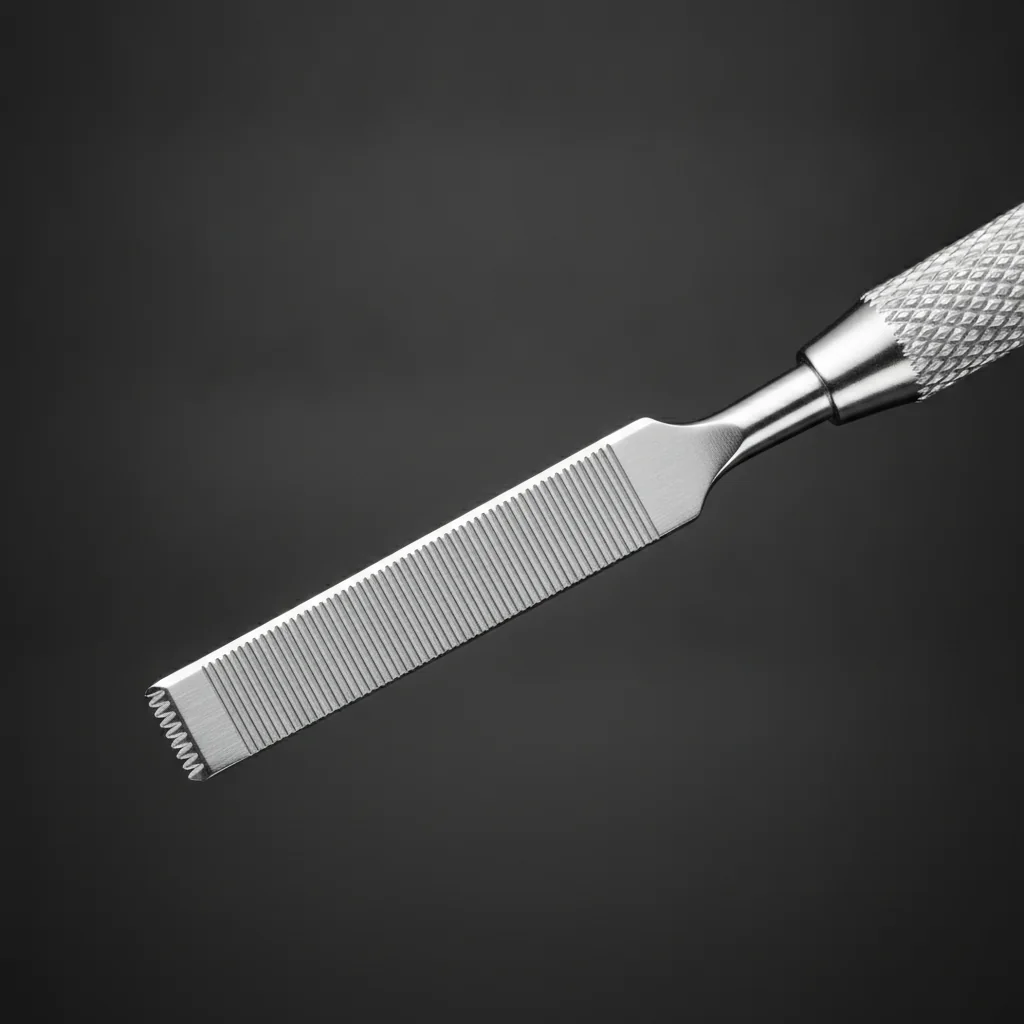
Dental Bone Files — Pattern and Clinical Use
Where a rongeur bites bone away in pieces, a bone file smooths what remains. Its serrated working surfaces are drawn across the alveolar crest in a pull stroke to remove fine spicules and round off sharp edges, leaving a ridge contour that will heal comfortably under the mucosa. The instrument is used on the pull stroke only — pushing tears tissue rather than filing bone.
The cut of the serrations determines how aggressively the file works. A coarse cut removes bone quickly but leaves a rougher surface; a fine cut finishes smoothly. Double-ended files commonly carry two different cuts or sizes.
Dental Bone Files Variants and Specifications
Standard bone file patterns.
| Variant | Specification / use |
|---|---|
| Miller pattern | Classic double-ended bone file |
| Howarth pattern | Alternative blade geometry |
| Coarse cut | Rapid bone removal |
| Fine cut | Smooth finishing of the ridge |
| Double-ended | Two cuts or sizes in one instrument |
| Straight / angled ends | Anterior and posterior access |
Material, Finish and Quality Control
We forge dental bone files from AISI 420 martensitic stainless. Serration cut is inspected for uniform depth and direction, since an uneven cut files unpredictably and can gouge rather than smooth. Each batch passes Rockwell hardness testing, dimensional checks on serration cut uniformity, and visual inspection under our ISO 13485 system before passivation and final finishing. Mirror and satin finishes are both available — satin is usually specified where glare under operating lights is a concern.
Who Sources Dental Bone Files From Surgical Star
Bone files sell alongside rongeurs in surgical extraction kits to dental and oral-surgery distributors, and are an inexpensive but essential set component.
OEM, Certification and Ordering
Every dental bone files can be produced as a private-label line: your logo laser-marked on the handle, your catalog numbers, and your own printed packaging, manufactured from your drawings or a reference sample. Production runs inside a documented ISO 13485 quality system, with CE marking under EU MDR 2017/745 and US FDA establishment registration behind it. Your shipment carries a certificate of conformity plus the ASTM F899 material certificate for the grade actually used.
Minimums stay deliberately low so a new brand can launch without a heavy first order, and pricing is quoted direct from the factory on volume tiers. Bulk production usually takes four to six weeks from sample approval, shipped DDP with export paperwork and HS codes handled. See how OEM & private label works →
Related Dental Instruments
Frequently Asked Questions
Is a bone file used on the push or pull stroke?
The pull stroke only. Pushing the file tears soft tissue rather than filing bone, so the cut of the serrations is oriented for pulling.
When would I use a file instead of a rongeur?
A rongeur removes bone in bites; a file smooths what remains. Most surgical extractions use the rongeur first and the file to finish.
What cut should we stock?
Double-ended files carrying a coarse and a fine cut are the most practical, letting the operator remove and then finish with one instrument.
Can you manufacture these under our own brand?
Yes — full OEM and private label. We laser-mark your logo and catalog numbers, pack in your branded boxes, and work from your drawings, tech pack or a reference sample, with a pre-production sample approved before any bulk run.
Send your pattern list, drawing or a reference sample and we’ll quote MOQ, pricing and lead time — standard catalog or fully private-label.
Request a Free Quote Order a Sample