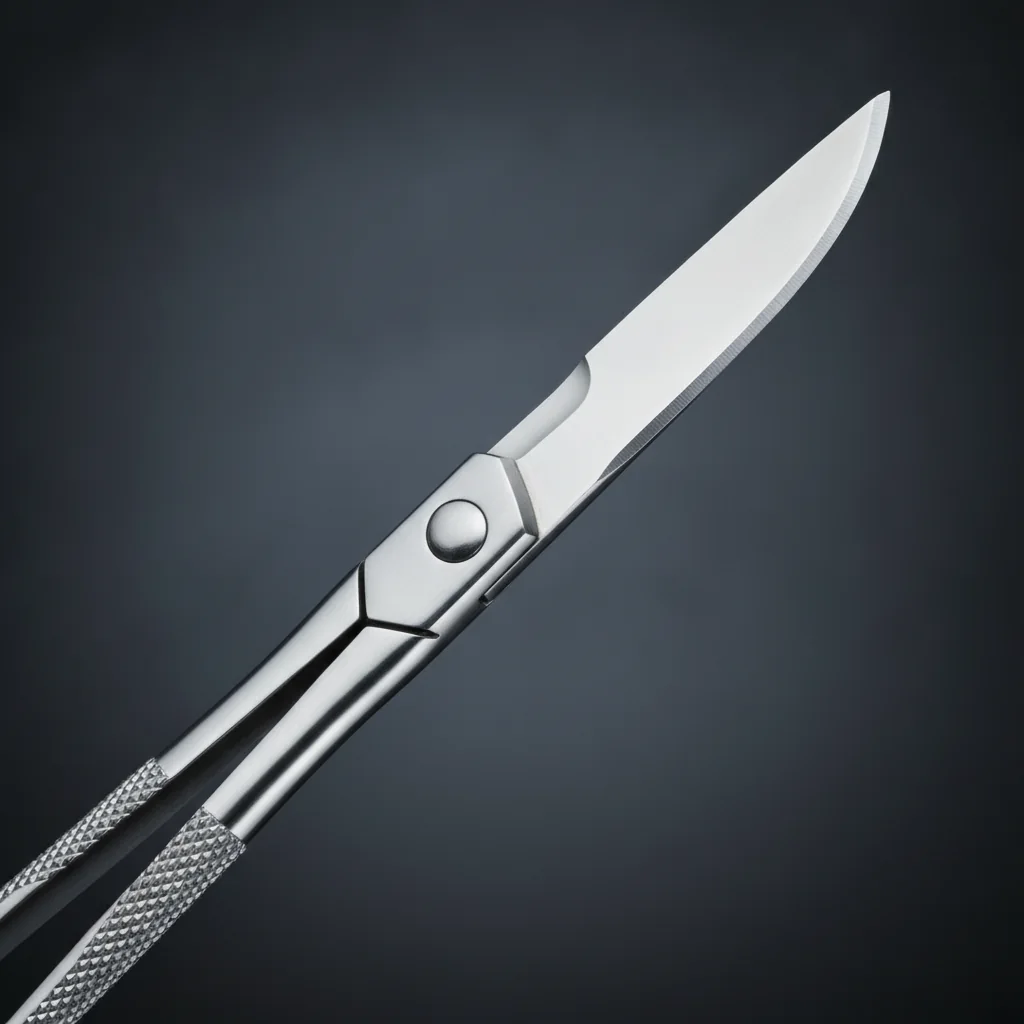
Lebsche Knives — Pattern and Clinical Use
The Lebsche divides the sternum without a powered saw. Its hooked foot slides beneath the sternum to guide the cut and protect the structures behind it, while the blade above is struck with a mallet to advance through the bone in controlled steps. That guided, protected cut is why it remains in sets even where oscillating saws are standard — it is the fallback when power fails and the instrument of choice in some re-do cases.
The foot must be smooth and correctly shaped, since it passes directly against the pericardium and mediastinal structures. Blade sharpness determines how many mallet blows are needed and therefore how much force is transmitted to the patient.
Lebsche Knives Variants and Specifications
Standard Lebsche patterns.
| Variant | Specification / use |
|---|---|
| Standard adult | Median sternotomy |
| Paediatric pattern | Scaled blade and foot |
| Hooked guide foot | Protects structures behind the sternum |
| Impact-rated handle | Withstands repeated mallet blows |
| Sharpened blade | Fewer blows, less transmitted force |
| Supplied with mallet | Complete working pair |
Material, Finish and Quality Control
We forge Lebsche knives from AISI 420 martensitic stainless. The guide foot is polished and profiled, and blade sharpness verified, since a dull blade requires more blows and transmits more force. Each batch passes Rockwell hardness testing, dimensional checks on foot profile and blade sharpness, and visual inspection under our ISO 13485 system before passivation and final finishing. Mirror and satin finishes are both available — satin is usually specified where glare under operating lights is a concern.
Who Sources Lebsche Knives From Surgical Star
Lebsche knives sell to cardiac surgical distributors as part of sternal sets, retained as the reliable non-powered option even where saws are standard.
OEM, Certification and Ordering
Every Lebsche knives can be produced as a private-label line: your logo laser-marked on the shank, your catalog numbers, and your own printed packaging, manufactured from your drawings or a reference sample. Manufactured under an ISO 13485 quality system, CE-marked to EU MDR 2017/745 and covered by US FDA establishment registration. A certificate of conformity and an ASTM F899 material certificate for the exact steel grade ship with your order.
MOQs are low and new-brand friendly, and vary with pattern, finish and branding. Pricing is direct from the factory and tiered by volume. After you approve a branded pre-production sample, bulk production typically runs four to six weeks and ships worldwide DDP with HS codes handled. See how OEM & private label works →
Related Cardiovascular & Thoracic Instruments
Frequently Asked Questions
Is the Lebsche knife obsolete now saws exist?
No. It remains in sets as the reliable non-powered option if power fails, and is preferred by some surgeons in re-do sternotomy.
What does the hooked foot do?
It slides beneath the sternum to guide the cut and protect the pericardium and mediastinal structures behind the bone.
Why does blade sharpness matter clinically?
A dull blade needs more mallet blows, which transmits more force to the patient. A sharp blade divides the sternum in fewer, gentler strikes.
Can you manufacture these under our own brand?
Yes — full OEM and private label. We laser-mark your logo and catalog numbers, pack in your branded boxes, and work from your drawings, tech pack or a reference sample, with a pre-production sample approved before any bulk run.
Send your pattern list, drawing or a reference sample and we’ll quote MOQ, pricing and lead time — standard catalog or fully private-label.
Request a Free Quote Order a Sample