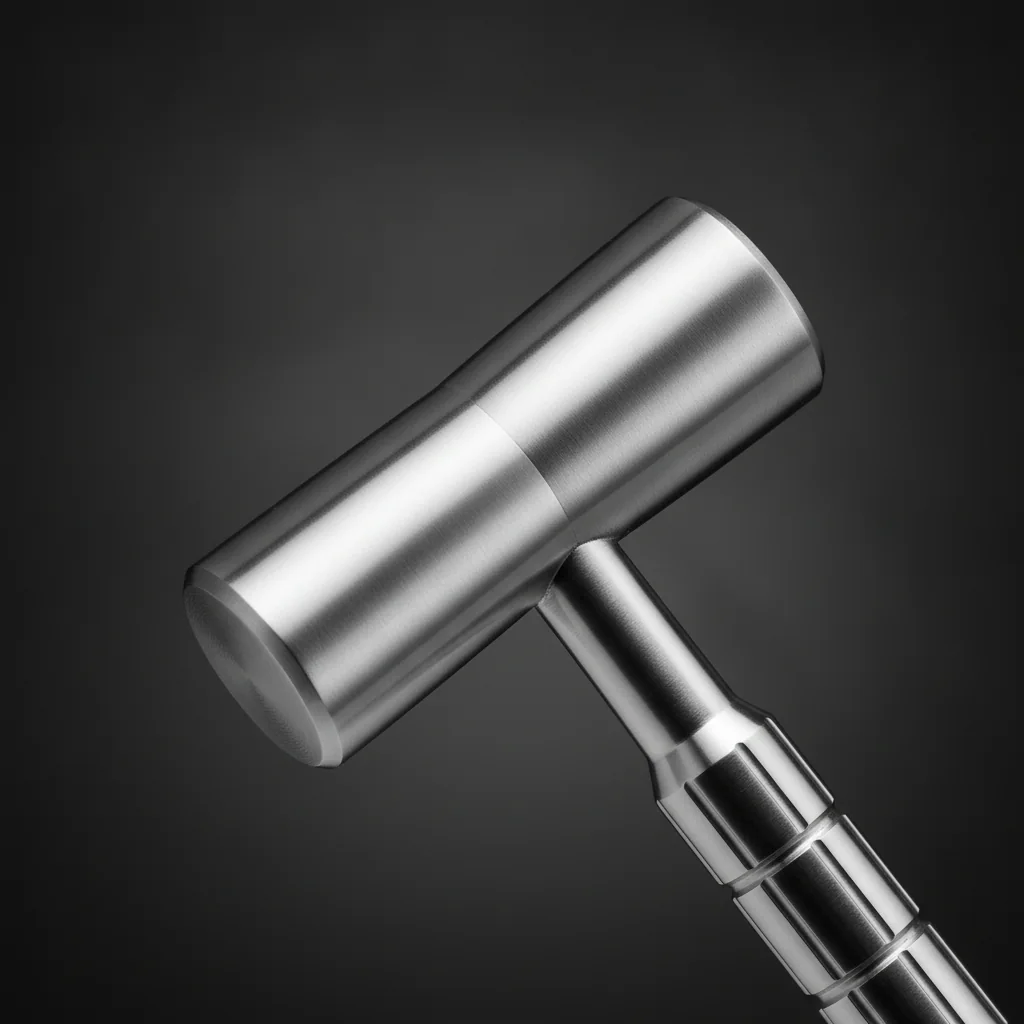
Surgical Mallets — Pattern and Clinical Use
The mallet delivers controlled impact energy. Head mass determines how much force each blow transmits, so surgeons select weight according to the bone and the instrument being driven — a light mallet for fine maxillofacial osteotomy, a heavy one for driving a chisel through cortical bone. Head material matters too: nylon and lead-filled heads absorb rebound and reduce the shock transmitted back through the surgeon’s hand.
Head-to-handle security is the safety-critical characteristic. A head that loosens in use is both a contamination and an injury risk, so one-piece and mechanically locked constructions are preferred over friction-fitted heads.
Surgical Mallets Variants and Specifications
Standard mallet patterns by head weight and material.
| Variant | Specification / use |
|---|---|
| Stainless head, 200–300 g | Fine osteotomy and maxillofacial |
| Stainless head, 450–900 g | General orthopedic bone work |
| Nylon-faced head | Reduced rebound and shock |
| Lead-filled head | Dead-blow; minimal rebound |
| Combination faces | Metal and nylon on one head |
| One-piece construction | Head cannot loosen |
Material, Finish and Quality Control
We forge surgical Mallets from 316L austenitic stainless. Head-to-handle security is proof-tested, since a head that loosens in use is both a contamination and an injury risk. Each batch passes Rockwell hardness testing, dimensional checks on head-to-handle retention, and visual inspection under our ISO 13485 system before passivation and final finishing. Mirror and satin finishes are both available — satin is usually specified where glare under operating lights is a concern.
Who Sources Surgical Mallets From Surgical Star
Surgical mallets sell across orthopedic, spinal, maxillofacial and dental implant catalogs, with weight range being the main ordering variable.
OEM, Certification and Ordering
Every surgical Mallets can be produced as a private-label line: your logo laser-marked on the handle, your catalog numbers, and your own printed packaging, manufactured from your drawings or a reference sample. Manufactured under an ISO 13485 quality system, CE-marked to EU MDR 2017/745 and covered by US FDA establishment registration. A certificate of conformity and an ASTM F899 material certificate for the exact steel grade ship with your order.
MOQs are low and new-brand friendly, and vary with pattern, finish and branding. Pricing is direct from the factory and tiered by volume. After you approve a branded pre-production sample, bulk production typically runs four to six weeks and ships worldwide DDP with HS codes handled. See how OEM & private label works →
Related Orthopedic Instruments
Frequently Asked Questions
What weight mallet should we stock?
A range. Light 200–300 g heads suit fine maxillofacial and implant work; 450–900 g heads are used for general orthopedic bone cutting.
What is a dead-blow mallet?
One with a lead-filled or shot-filled head that absorbs rebound, delivering energy into the bone rather than bouncing back through the surgeon’s hand.
Why does head security matter?
A head that loosens in use is a contamination and injury risk, so one-piece or mechanically locked construction is preferred over friction fits.
Can you manufacture these under our own brand?
Yes — full OEM and private label. We laser-mark your logo and catalog numbers, pack in your branded boxes, and work from your drawings, tech pack or a reference sample, with a pre-production sample approved before any bulk run.
Send your pattern list, drawing or a reference sample and we’ll quote MOQ, pricing and lead time — standard catalog or fully private-label.
Request a Free Quote Order a Sample