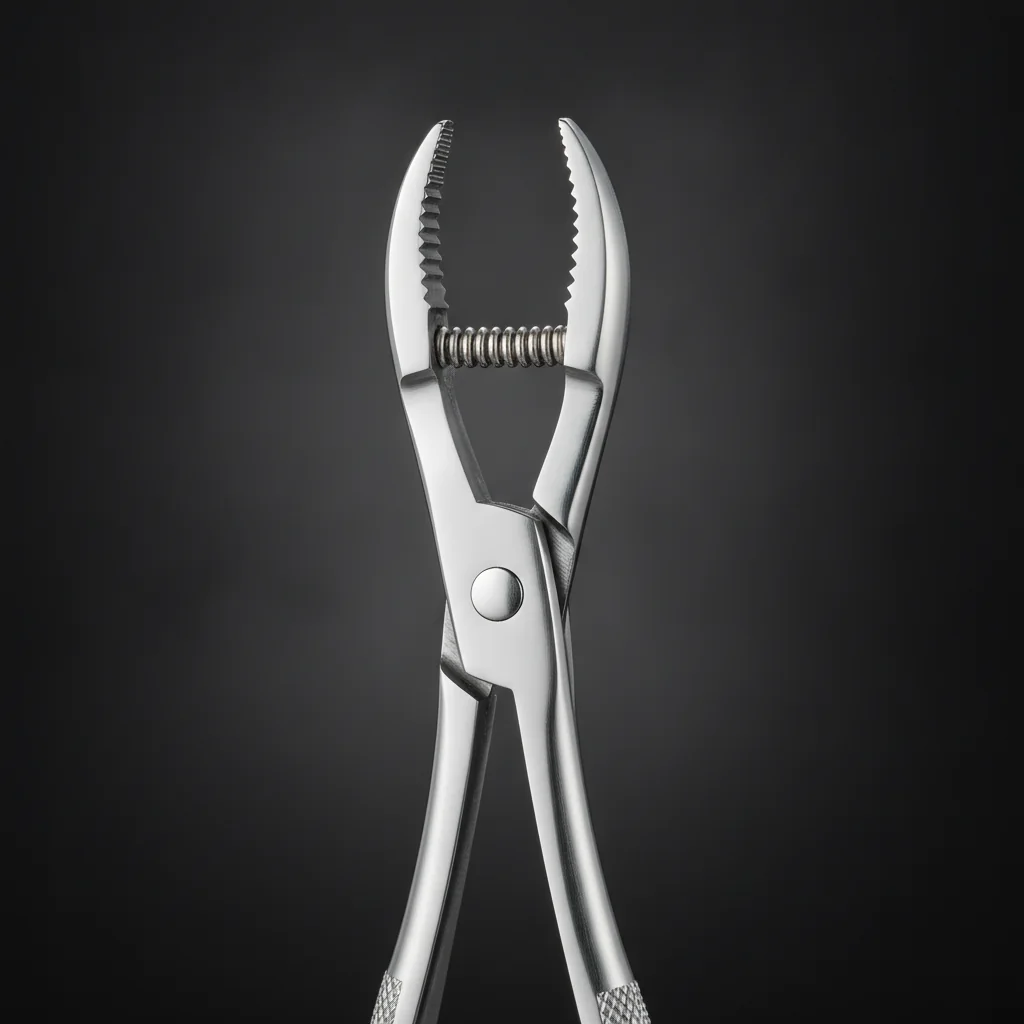
Cast Spreaders — Pattern and Clinical Use
Once a cast has been cut along its length, the shell still grips the limb and must be opened. The spreader’s jaws are inserted into the cut and the handles squeezed, forcing the cast edges apart far enough to lift the shell off. Without it, a cut cast has to be prised open by hand, which is awkward and risks pinching the patient.
Jaw tips must be thin enough to enter a saw kerf but strong enough to force apart a rigid fibreglass shell — a combination that puts high stress on a thin section, making tip strength the critical characteristic.
Cast Spreaders Variants and Specifications
Standard cast spreader patterns.
| Variant | Specification / use |
|---|---|
| Wolff pattern | Classic cast spreader |
| Henning pattern | Alternative jaw geometry |
| Thin entry tips | Enters a narrow saw kerf |
| Wide spreading jaw | Opens rigid fibreglass shells |
| Long handle | Increased spreading force |
| Serrated grip face | Prevents slipping out of the kerf |
Material, Finish and Quality Control
We forge Cast Spreaders from AISI 420 martensitic stainless. Jaw tips are strength-tested at their thinnest section, since they must enter a narrow kerf yet force apart a rigid shell. Each batch passes Rockwell hardness testing, dimensional checks on tip strength at thin section, and visual inspection under our ISO 13485 system before passivation and final finishing. Mirror and satin finishes are both available — satin is usually specified where glare under operating lights is a concern.
Who Sources Cast Spreaders From Surgical Star
Cast spreaders sell to fracture clinics, orthopedic departments and emergency departments as part of a cast-removal set with shears and saws.
OEM, Certification and Ordering
Every Cast Spreaders can be produced as a private-label line: your logo laser-marked on the handle, your catalog numbers, and your own printed packaging, manufactured from your drawings or a reference sample. Manufactured under an ISO 13485 quality system, CE-marked to EU MDR 2017/745 and covered by US FDA establishment registration. A certificate of conformity and an ASTM F899 material certificate for the exact steel grade ship with your order.
MOQs are low and new-brand friendly, and vary with pattern, finish and branding. Pricing is direct from the factory and tiered by volume. After you approve a branded pre-production sample, bulk production typically runs four to six weeks and ships worldwide DDP with HS codes handled. See how OEM & private label works →
Related Orthopedic Instruments
Frequently Asked Questions
Why is a spreader needed after cutting?
A cut cast still grips the limb. The spreader forces the edges apart far enough for the shell to be lifted off without prising it by hand.
What makes the tips demanding to manufacture?
They must be thin enough to enter a saw kerf yet strong enough to force apart a rigid fibreglass shell, which puts high stress on a thin section.
Is it used on fibreglass as well as plaster?
Yes, and fibreglass is the harder test — the shell is more rigid and springs back more, so spreading force matters more.
Can you manufacture these under our own brand?
Yes — full OEM and private label. We laser-mark your logo and catalog numbers, pack in your branded boxes, and work from your drawings, tech pack or a reference sample, with a pre-production sample approved before any bulk run.
Send your pattern list, drawing or a reference sample and we’ll quote MOQ, pricing and lead time — standard catalog or fully private-label.
Request a Free Quote Order a Sample