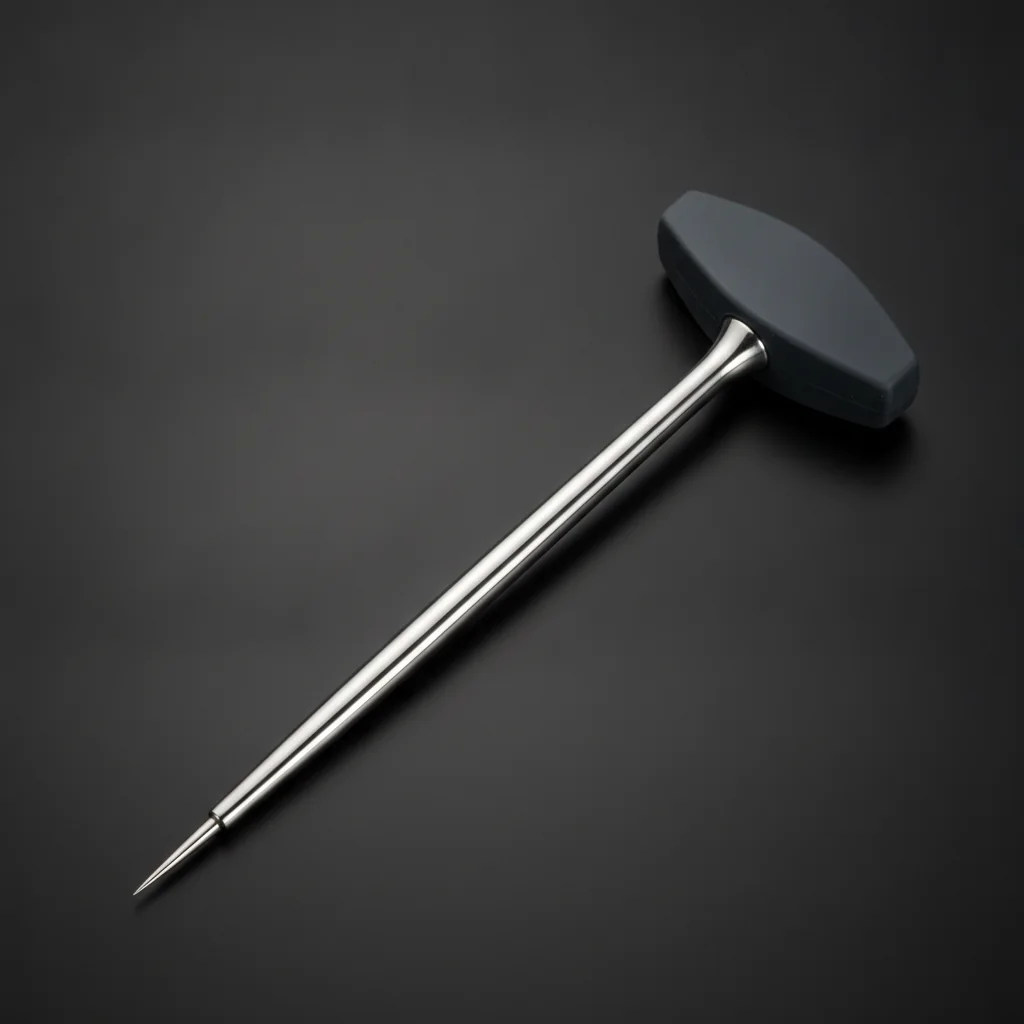
Reflex Hammers — Pattern and Clinical Use
A reflex hammer works by delivering a brief, consistent tap that stretches the tendon suddenly enough to trigger the stretch reflex. Head weight and the swing the handle allows determine whether that stimulus is adequate — too light a hammer produces false absent reflexes, which is a diagnostic error rather than an inconvenience. Different patterns suit different techniques and body regions.
The striking surface must be a resilient rubber or elastomer that transmits impulse without bruising, and it must stay bonded to the head. A perished or detached striking face is the usual reason hammers are replaced.
Reflex Hammers Variants and Specifications
The main reflex hammer patterns.
| Pattern | Characteristics / use |
|---|---|
| Taylor (tomahawk) | Triangular rubber head, most widely used |
| Queen Square | Long handle, disc head, pendulum swing |
| Babinski | Weighted disc head, telescoping handle |
| Buck | Double-ended head, pointed and flat faces |
| Trömner | Two-headed, for fine reflex work |
| With built-in brush or point | Sensory testing accessory |
Material, Finish and Quality Control
We forge Reflex hammers from 316L austenitic stainless. Striking-face bonding is tested and head weight verified to pattern, since an under-weighted hammer produces false absent reflexes. Each batch passes Rockwell hardness testing, dimensional checks on head weight and striking-face bonding, and visual inspection under our ISO 13485 system before passivation and final finishing. Mirror and satin finishes are both available — satin is usually specified where glare under operating lights is a concern.
Who Sources Reflex Hammers From Surgical Star
Reflex hammers sell to neurology, general practice and medical-education suppliers, and are a strong retail and student-market private-label item as well as a clinical one.
OEM, Certification and Ordering
Every Reflex hammers can be produced as a private-label line: your logo laser-marked on the handle, your catalog numbers, and your own printed packaging, manufactured from your drawings or a reference sample. Our quality file is ISO 13485, our EU route is CE marking under MDR 2017/745, and our facility holds US FDA establishment registration. Conformity and ASTM F899 material certificates are issued against each order.
You order direct from the factory with no trading-house margin, on volume-tiered pricing and a minimum matched to your pattern and finish. Once your branded sample is signed off, expect roughly four to six weeks to bulk delivery, worldwide DDP. See how OEM & private label works →
Related Diagnostic Instruments
Frequently Asked Questions
Which reflex hammer pattern is best?
Taylor is the most widely used and familiar; Queen Square and Babinski patterns give a heavier, more consistent pendulum swing that many neurologists prefer.
Why does head weight matter?
Too light a hammer fails to stretch the tendon adequately and produces a false absent reflex, which is a diagnostic error.
Why do hammers get replaced?
Usually because the rubber striking face perishes or detaches from the head, rather than any failure of the metal.
Can you manufacture these under our own brand?
Yes — full OEM and private label. We laser-mark your logo and catalog numbers, pack in your branded boxes, and work from your drawings, tech pack or a reference sample, with a pre-production sample approved before any bulk run.
Send your pattern list, drawing or a reference sample and we’ll quote MOQ, pricing and lead time — standard catalog or fully private-label.
Request a Free Quote Order a Sample