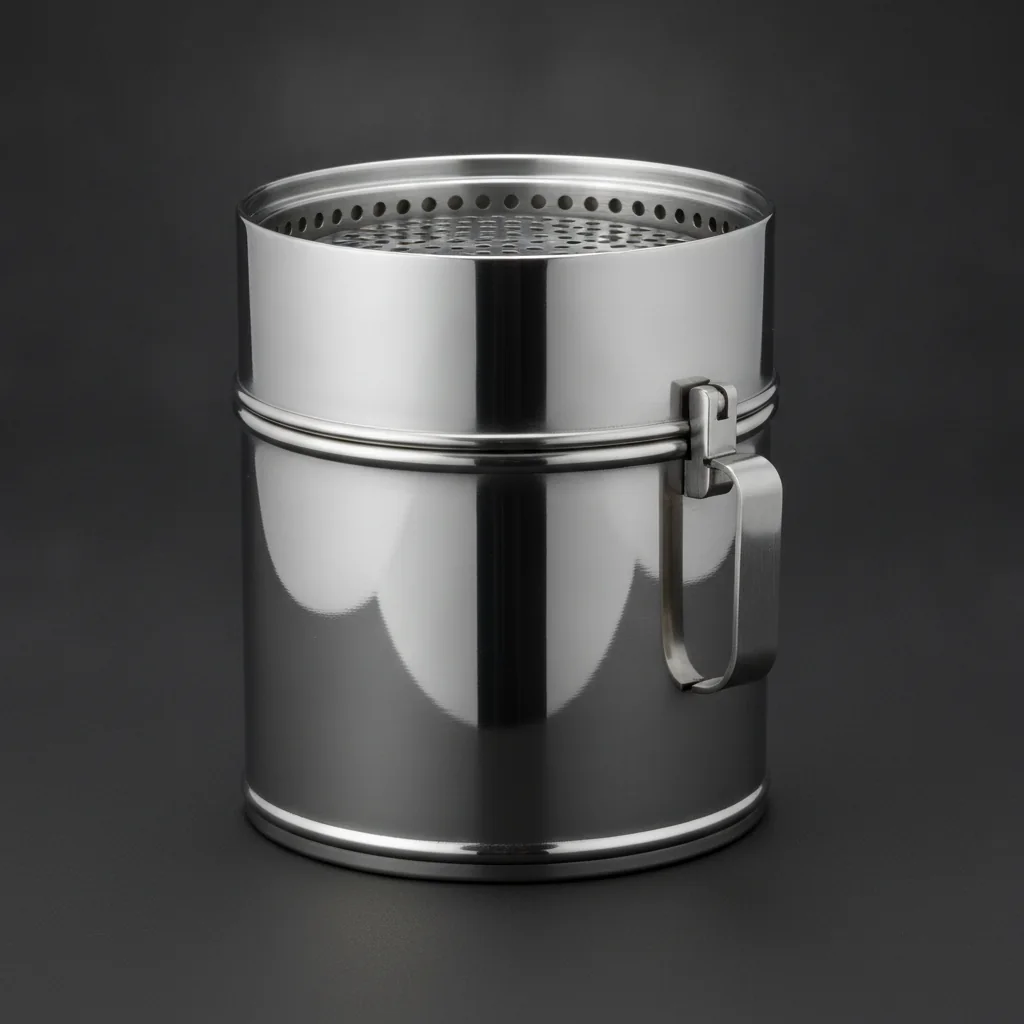
Dressing Drums — Pattern and Clinical Use
A drum is loaded with dressings, its side vents opened, and autoclaved — steam enters through the vents and penetrates the contents. The vents are then closed before the drum is removed, sealing the sterile contents inside for storage. That vent mechanism is the whole principle, and the reason drums remain in use where wrapped packs are impractical.
Vent band operation is the critical function: bands that stick, or that do not seal fully when closed, break the sterile barrier. The band and its seating must stay true after repeated thermal cycling.
Dressing Drums Variants and Specifications
Standard dressing drum sizes.
| Size | Typical use |
|---|---|
| Small (150–200 mm) | Small dressing quantities |
| Medium (250–300 mm) | General ward supply |
| Large (350–400 mm) | Theatre linen and bulk dressings |
| Sliding vent band | Opens and seals the vents |
| With carrying handles | Loaded transport |
| Index plate | Records contents and cycle |
Material, Finish and Quality Control
We forge dressing drums from 316L austenitic stainless. Vent band operation is cycled after thermal testing to confirm it slides freely and seals fully when closed. Each batch passes Rockwell hardness testing, dimensional checks on vent band operation and seal, and visual inspection under our ISO 13485 system before passivation and final finishing. Mirror and satin finishes are both available — satin is usually specified where glare under operating lights is a concern.
Who Sources Dressing Drums From Surgical Star
Dressing drums sell to hospital sterile services and ward suppliers, particularly in markets where drum sterilisation remains standard practice over wrapped packs.
OEM, Certification and Ordering
Every dressing drums can be produced under your own brand: your logo laser-marked, your catalog numbers, and your labelling applied before the set is packed. Production runs inside a documented ISO 13485 quality system, with CE marking under EU MDR 2017/745 and US FDA establishment registration behind it. Your shipment carries a certificate of conformity plus the ASTM F899 material certificate for the grade actually used.
Minimums stay deliberately low so a new brand can launch without a heavy first order, and pricing is quoted direct from the factory on volume tiers. Bulk production usually takes four to six weeks from sample approval, shipped DDP with export paperwork and HS codes handled. See how OEM & private label works →
Related Holloware & Sterilization Instruments
Frequently Asked Questions
How does a dressing drum work?
Vents are opened for the autoclave cycle so steam penetrates the contents, then closed before removal to seal the sterile contents for storage.
What is the critical part?
The vent band. If it sticks or fails to seal fully when closed, the sterile barrier is broken with no visible sign.
Are drums still used?
Yes, particularly where wrapped packs are impractical and in markets where drum sterilisation remains established practice.
Can you manufacture these under our own brand?
Yes — full OEM and private label. We laser-mark your logo and catalog numbers, pack in your branded boxes, and work from your drawings, tech pack or a reference sample, with a pre-production sample approved before any bulk run.
Send your pattern list, drawing or a reference sample and we’ll quote MOQ, pricing and lead time — standard catalog or fully private-label.
Request a Free Quote Order a Sample