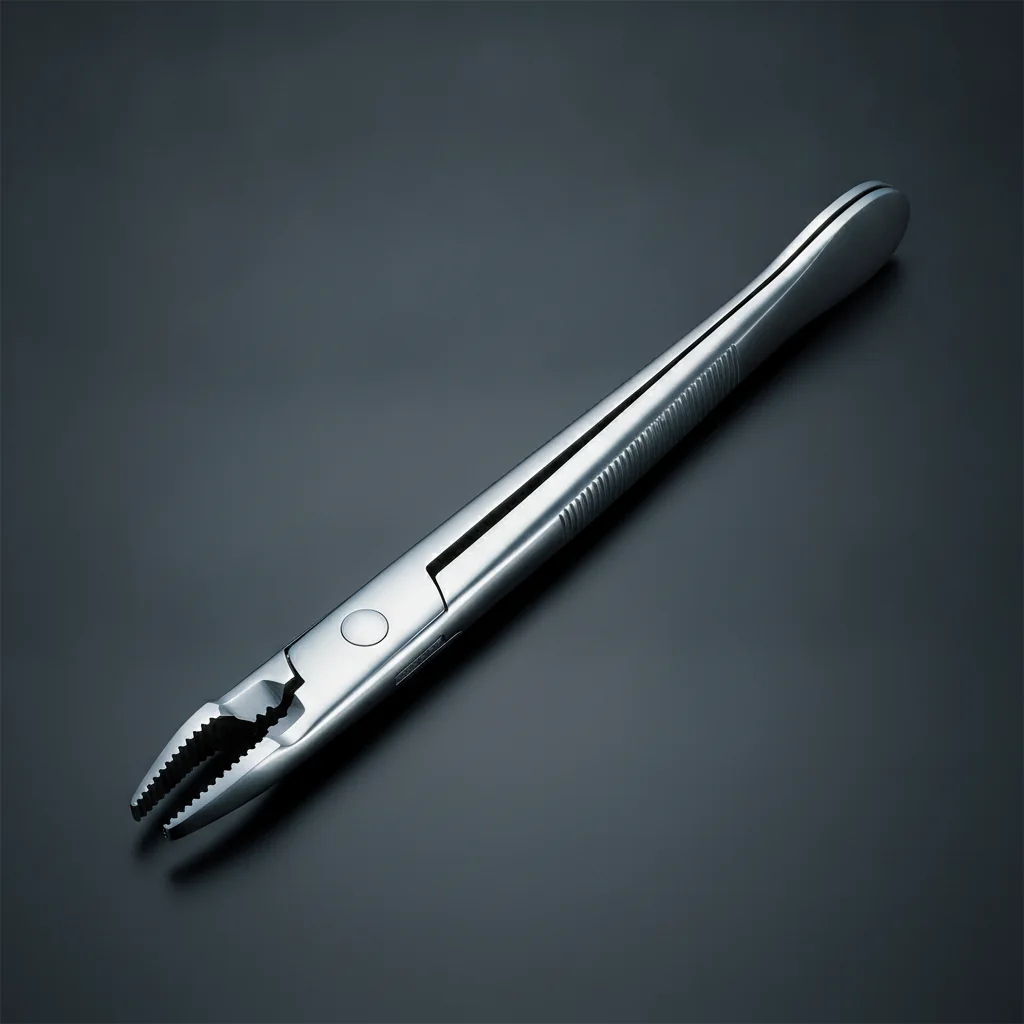
Kocher Forceps — Pattern and Clinical Use
The tip teeth are what define this pattern. They bite into tough, slippery tissue that plain serrations would let slide — fascia, aponeurosis and dense connective tissue — which makes the Kocher the clamp of choice when grip matters more than atraumatic handling. That same feature makes it unsuitable for delicate tissue or for clamping a vessel you intend to preserve.
The 1×2 tooth arrangement must interlock cleanly. If the teeth are mismatched or the jaws close slightly out of line, the instrument either fails to grip or crushes unevenly, so tooth meshing is the critical inspection point.
Kocher Forceps Variants and Specifications
Standard Kocher / Ochsner patterns.
| Variant | Specification / use |
|---|---|
| Straight, 14–24 cm | Gripping tough tissue in the line of sight |
| Curved, 14–24 cm | Gripping at depth |
| 1×2 interlocking teeth | Defining feature; prevents slippage on fascia |
| Heavy jaw | For dense connective tissue |
| Mirror or satin finish | Buyer preference |
Material, Finish and Quality Control
We forge Kocher forceps from AISI 420 martensitic stainless. Tooth meshing is checked with the ratchet closed to confirm the 1×2 teeth interlock cleanly rather than butting or crossing. Each batch passes Rockwell hardness testing, dimensional checks on tooth interlock, and visual inspection under our ISO 13485 system before passivation and final finishing. Mirror and satin finishes are both available — satin is usually specified where glare under operating lights is a concern.
Who Sources Kocher Forceps From Surgical Star
Kocher forceps are standard in general, orthopedic and veterinary sets wherever tough tissue must be held securely, and are a steady catalog line for hospital and veterinary distributors.
OEM, Certification and Ordering
Every Kocher forceps can be produced as a private-label line: your logo laser-marked on the shank, your catalog numbers, and your own printed packaging, manufactured from your drawings or a reference sample. Production runs inside a documented ISO 13485 quality system, with CE marking under EU MDR 2017/745 and US FDA establishment registration behind it. Your shipment carries a certificate of conformity plus the ASTM F899 material certificate for the grade actually used.
Minimums stay deliberately low so a new brand can launch without a heavy first order, and pricing is quoted direct from the factory on volume tiers. Bulk production usually takes four to six weeks from sample approval, shipped DDP with export paperwork and HS codes handled. See how OEM & private label works →
Related General Surgery Instruments
Frequently Asked Questions
Are Kocher and Ochsner forceps the same instrument?
Yes. The two names refer to the same toothed clamp pattern and are used interchangeably depending on the market.
Why do Kocher forceps have teeth?
To grip tough, slippery structures such as fascia that plain serrations would let slide. The trade-off is that they are traumatic and are not used on delicate tissue.
Can Kocher forceps be used as a hemostat?
They can clamp a vessel, but the teeth are traumatic. Where the vessel or tissue is to be preserved, a plain-jawed Crile or Rochester-Pean is the better choice.
Can you manufacture these under our own brand?
Yes — full OEM and private label. We laser-mark your logo and catalog numbers, pack in your branded boxes, and work from your drawings, tech pack or a reference sample, with a pre-production sample approved before any bulk run.
Send your pattern list, drawing or a reference sample and we’ll quote MOQ, pricing and lead time — standard catalog or fully private-label.
Request a Free Quote Order a Sample