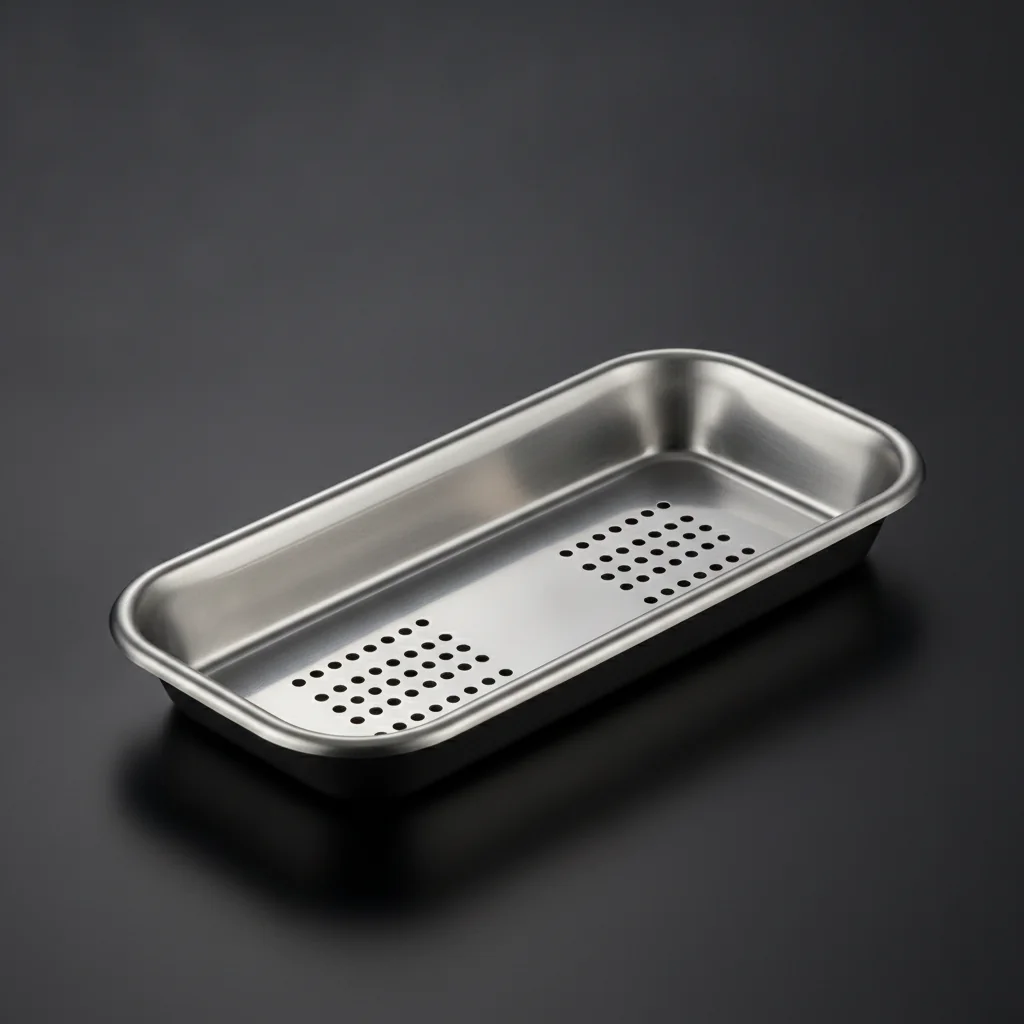
Instrument Trays — Pattern and Clinical Use
A tray holds a set through its whole cycle: laid up in theatre, used, returned to sterile services, washed, reassembled and autoclaved. That means it must drain fully, allow steam to reach every instrument, and survive the mechanical handling of a washer-disinfector repeatedly. Perforated bases are standard because they permit both drainage and steam penetration.
Tray dimensions are usually standardised to fit sterilisation containers and washer racks, so buyers must specify the system the tray must fit. Handles must fold or sit flush so trays stack without fouling.
Instrument Trays Variants and Specifications
Standard instrument tray configurations.
| Variant | Specification / use |
|---|---|
| Perforated base | Drainage and steam penetration |
| Solid base | Fluid containment |
| With lid | Covered transport |
| Half / full DIN size | Fits standard container systems |
| Folding handles | Stacks without fouling |
| Silicone instrument mat | Protects delicate instruments |
Material, Finish and Quality Control
We forge Instrument trays from 316L austenitic stainless. Perforation edges are deburred and dimensions gauged against standard container systems so trays fit and drain correctly. Each batch passes Rockwell hardness testing, dimensional checks on perforation deburring and dimensional fit, and visual inspection under our ISO 13485 system before passivation and final finishing. Mirror and satin finishes are both available — satin is usually specified where glare under operating lights is a concern.
Who Sources Instrument Trays From Surgical Star
Instrument trays sell to sterile services departments and hospital distributors, where fit with the existing container and washer system determines the specification entirely.
OEM, Certification and Ordering
Every Instrument trays can be produced under your own brand: your logo laser-marked, your catalog numbers, and your labelling applied before the set is packed. Production runs inside a documented ISO 13485 quality system, with CE marking under EU MDR 2017/745 and US FDA establishment registration behind it. Your shipment carries a certificate of conformity plus the ASTM F899 material certificate for the grade actually used.
Minimums stay deliberately low so a new brand can launch without a heavy first order, and pricing is quoted direct from the factory on volume tiers. Bulk production usually takes four to six weeks from sample approval, shipped DDP with export paperwork and HS codes handled. See how OEM & private label works →
Related Holloware & Sterilization Instruments
Frequently Asked Questions
Perforated or solid base?
Perforated is standard because it allows drainage and steam penetration during sterilisation. Solid bases are used where fluid must be contained.
Do trays need to match a container system?
Yes. Tray dimensions are standardised to fit sterilisation containers and washer racks, so the system in use must be specified.
Why do handles fold?
So trays stack cleanly in storage and in the autoclave without handles fouling the tray above.
Can you manufacture these under our own brand?
Yes — full OEM and private label. We laser-mark your logo and catalog numbers, pack in your branded boxes, and work from your drawings, tech pack or a reference sample, with a pre-production sample approved before any bulk run.
Send your pattern list, drawing or a reference sample and we’ll quote MOQ, pricing and lead time — standard catalog or fully private-label.
Request a Free Quote Order a Sample