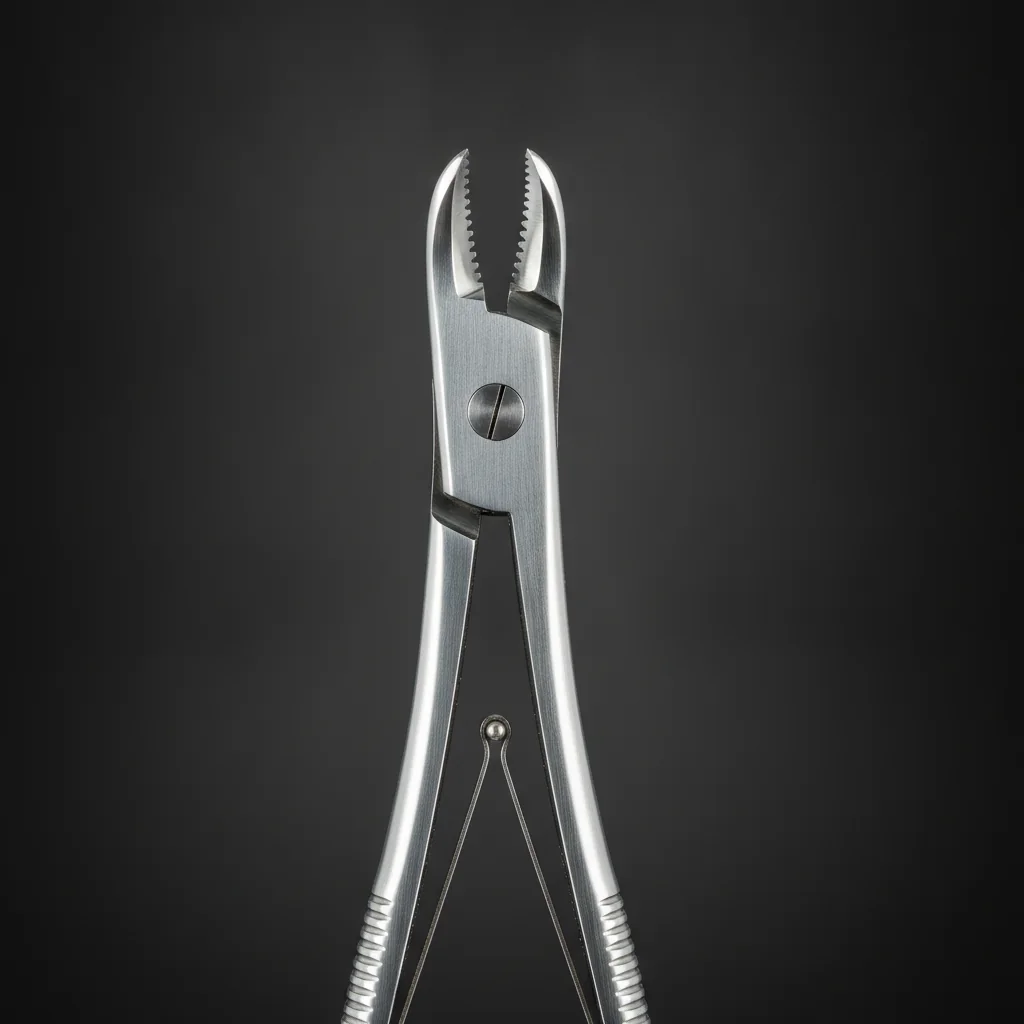
Ligature Cutters — Pattern and Clinical Use
Ligature cutters work in the tightest space in orthodontics — right at the bracket, against the tooth surface. The blades are short and set at an angle that lets the tip reach a twisted ligature without the handles fouling the adjacent teeth, and they must cut fine stainless ligature wire cleanly rather than crushing it, because a crushed end leaves a sharp tag that irritates the cheek.
These are not general wire cutters. Cutting archwire with a ligature cutter is the fastest way to destroy it, because the blades are ground fine for 0.010in ligature wire, not for a 0.019 x 0.025in stainless archwire.
Ligature Cutters Variants and Specifications
Standard ligature cutter patterns. Blade angle and tip fineness are the ordering variables.
| Variant | Specification / use |
|---|---|
| Standard tip | General ligature and elastomeric cutting |
| Fine / slim tip | Confined posterior access |
| 15-degree angled head | Improved reach at the bracket |
| Tungsten-carbide inserts | Extended edge life on stainless ligature |
| Safety-hold tip | Retains the cut end so it is not dropped |
| Box-joint construction | Reduced side play at the pivot |
Material, Finish and Quality Control
We forge ligature cutters from AISI 420 stainless with tungsten-carbide inserts. Blades are closed and inspected under magnification for full-length meeting, since a fine cutter that meets only at the tip leaves a tag rather than a clean cut. Each batch passes Rockwell hardness testing, dimensional checks on blade meeting under magnification, and visual inspection under our ISO 13485 system before passivation and final finishing. Mirror and satin finishes are both available — satin is usually specified where glare under operating lights is a concern.
Who Sources Ligature Cutters From Surgical Star
Ligature cutters are the highest-turnover cutter in an orthodontic practice because they are used at every adjustment appointment, which makes them a strong repeat line for orthodontic distributors.
OEM, Certification and Ordering
Every ligature cutters can be produced as a private-label line: your logo laser-marked on the handle, your catalog numbers, and your own printed packaging, manufactured from your drawings or a reference sample. Manufactured under an ISO 13485 quality system, CE-marked to EU MDR 2017/745 and covered by US FDA establishment registration. A certificate of conformity and an ASTM F899 material certificate for the exact steel grade ship with your order.
MOQs are low and new-brand friendly, and vary with pattern, finish and branding. Pricing is direct from the factory and tiered by volume. After you approve a branded pre-production sample, bulk production typically runs four to six weeks and ships worldwide DDP with HS codes handled. See how OEM & private label works →
Related Orthodontic Instruments
Frequently Asked Questions
Can ligature cutters cut archwire?
No — they will be ruined. The blades are ground fine for 0.010in ligature wire. Archwire requires a distal end cutter or a dedicated hard-wire cutter.
Why specify a safety-hold tip?
It retains the cut ligature end in the beaks instead of letting it drop into the patient’s mouth, which is why many practices now specify it as standard.
Are tungsten-carbide inserts worth it?
Yes on this pattern. Stainless ligature wire is abrasive and the blades are fine, so carbide inserts extend usable life considerably.
Can you manufacture these under our own brand?
Yes — full OEM and private label. We laser-mark your logo and catalog numbers, pack in your branded boxes, and work from your drawings, tech pack or a reference sample, with a pre-production sample approved before any bulk run.
Send your pattern list, drawing or a reference sample and we’ll quote MOQ, pricing and lead time — standard catalog or fully private-label.
Request a Free Quote Order a Sample