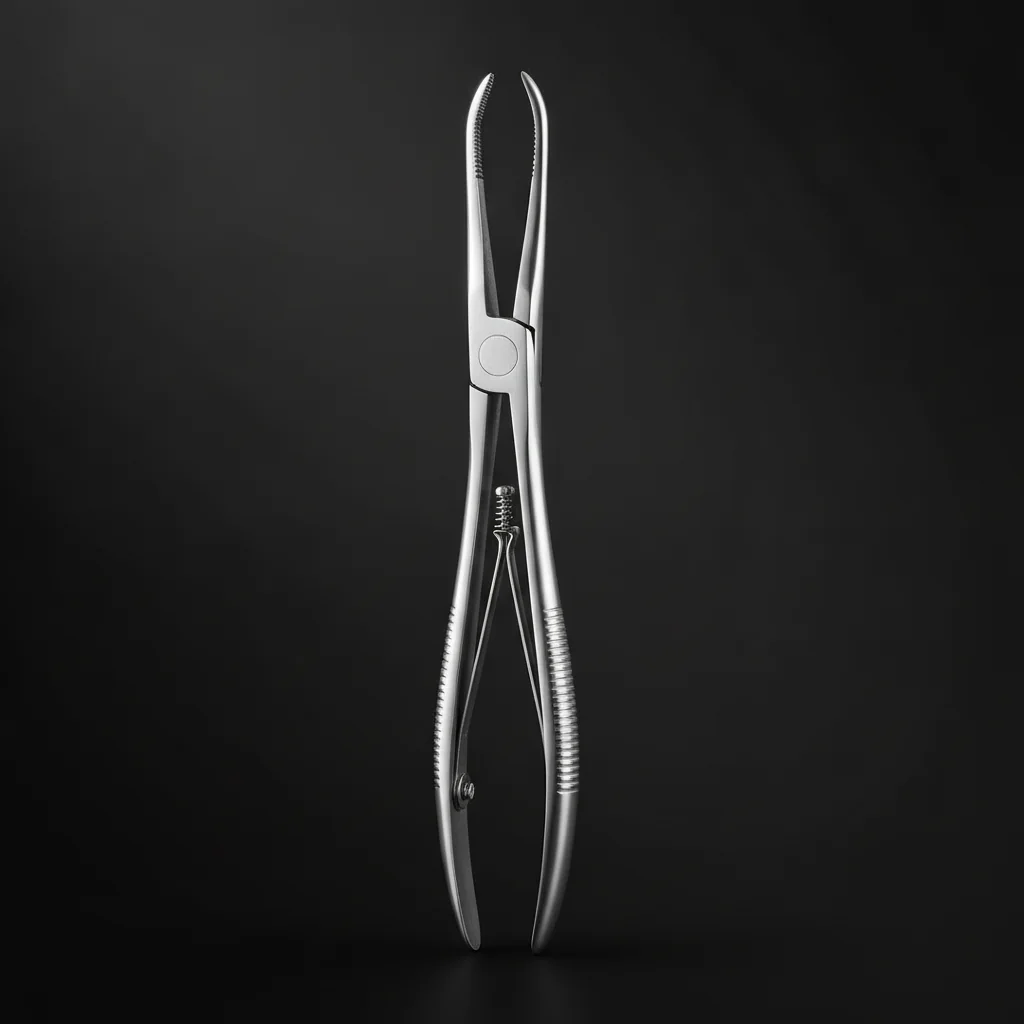
Torquing Pliers — Pattern and Clinical Use
Torque is the rotational component of tooth movement, and it is placed by twisting a rectangular archwire along its long axis. That requires two pliers working together: one holds the wire stationary while the other rotates the adjacent segment through a controlled angle. The beaks grip the rectangular section flat so the twist is applied to the wire rather than bending it.
Because they are used as a pair, the two pliers must grip identically — mismatched beak dimensions mean the wire is held differently at each end and the resulting torque is not what the operator intended.
Torquing Pliers Variants and Specifications
Standard torquing patterns — supplied and used in pairs.
| Variant | Specification / use |
|---|---|
| Torquing plier pair | Standard ordering unit |
| Rectangular wire slot | Grips the wire flat for true twist |
| Sized for 0.018in slot | Matched to appliance prescription |
| Sized for 0.022in slot | Matched to appliance prescription |
| Tungsten-carbide inserts | Extended life on hardened wire |
| Box-joint construction | Precision under torsional load |
Material, Finish and Quality Control
We forge torquing pliers from AISI 420 stainless with tungsten-carbide inserts. The pair is gauged together so both pliers grip identically, because mismatched beaks produce torque other than what the operator set. Each batch passes Rockwell hardness testing, dimensional checks on matched beak dimensions across the pair, and visual inspection under our ISO 13485 system before passivation and final finishing. Mirror and satin finishes are both available — satin is usually specified where glare under operating lights is a concern.
Who Sources Torquing Pliers From Surgical Star
Torquing pliers sell as matched pairs to orthodontic practices placing individualised torque, and are specified by slot size, so distributors should carry both common prescriptions.
OEM, Certification and Ordering
Every torquing pliers can be produced as a private-label line: your logo laser-marked on the handle, your catalog numbers, and your own printed packaging, manufactured from your drawings or a reference sample. Production runs inside a documented ISO 13485 quality system, with CE marking under EU MDR 2017/745 and US FDA establishment registration behind it. Your shipment carries a certificate of conformity plus the ASTM F899 material certificate for the grade actually used.
Minimums stay deliberately low so a new brand can launch without a heavy first order, and pricing is quoted direct from the factory on volume tiers. Bulk production usually takes four to six weeks from sample approval, shipped DDP with export paperwork and HS codes handled. See how OEM & private label works →
Related Orthodontic Instruments
Frequently Asked Questions
Why are torquing pliers used in pairs?
One holds the wire stationary while the other rotates the adjacent segment. A single plier cannot place a controlled twist.
Do they need to match slot size?
Yes. Beaks are sized to the appliance prescription — commonly 0.018in or 0.022in — so the wire is gripped correctly.
What is third-order torque?
The rotational movement of a tooth about its long axis, produced by twisting a rectangular archwire so it engages the bracket slot at an angle.
Can you manufacture these under our own brand?
Yes — full OEM and private label. We laser-mark your logo and catalog numbers, pack in your branded boxes, and work from your drawings, tech pack or a reference sample, with a pre-production sample approved before any bulk run.
Send your pattern list, drawing or a reference sample and we’ll quote MOQ, pricing and lead time — standard catalog or fully private-label.
Request a Free Quote Order a Sample