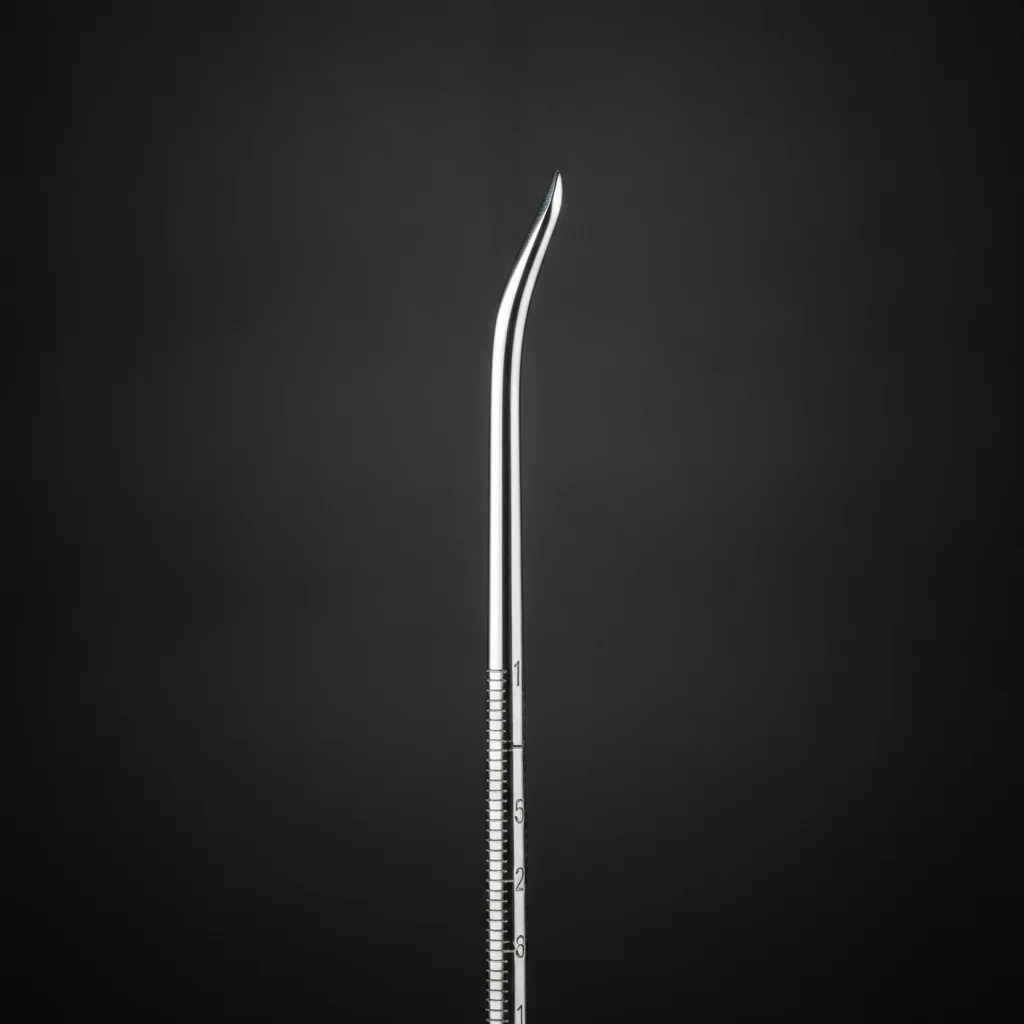
Uterine Sounds — Pattern and Clinical Use
Before an IUD insertion, D&C or hysteroscopy the clinician must know how deep the uterine cavity is and which way it lies, because instruments passed without that knowledge risk perforation. The sound is passed gently through the cervical canal until it meets the fundus, and the graduations read at the external os give the depth in centimetres. Its malleability lets it follow an anteverted or retroverted uterus.
The tip is bulbous and highly polished for a reason: it is passed blind into a hollow organ, and a sharp or rough tip is exactly what causes perforation. Sounds must bend to follow uterine position but not kink.
Uterine Sounds Variants and Specifications
Standard uterine sound patterns.
| Variant | Specification / use |
|---|---|
| Sims malleable | Bends to follow uterine version |
| Simpson | Classic graduated pattern |
| Graduated in cm | Direct depth reading |
| Bulbous tip | Reduces perforation risk |
| Flexible shaft | Follows anteverted or retroverted uterus |
| 316L construction | Repeated autoclaving |
Material, Finish and Quality Control
We forge uterine sounds from 316L austenitic stainless. Tip bulb polish and graduation accuracy are both checked, since the instrument is passed blind and the reading guides subsequent instrumentation. Each batch passes Rockwell hardness testing, dimensional checks on tip polish and graduation accuracy, and visual inspection under our ISO 13485 system before passivation and final finishing. Mirror and satin finishes are both available — satin is usually specified where glare under operating lights is a concern.
Who Sources Uterine Sounds From Surgical Star
Uterine sounds sell to gynecology, family planning and hospital distributors as a standard component of IUD insertion and D&C sets.
OEM, Certification and Ordering
Every uterine sounds can be produced as a private-label line: your logo laser-marked on the shaft, your catalog numbers, and your own printed packaging, manufactured from your drawings or a reference sample. Manufactured under an ISO 13485 quality system, CE-marked to EU MDR 2017/745 and covered by US FDA establishment registration. A certificate of conformity and an ASTM F899 material certificate for the exact steel grade ship with your order.
MOQs are low and new-brand friendly, and vary with pattern, finish and branding. Pricing is direct from the factory and tiered by volume. After you approve a branded pre-production sample, bulk production typically runs four to six weeks and ships worldwide DDP with HS codes handled. See how OEM & private label works →
Related Gynecology & Obstetrics Instruments
Frequently Asked Questions
Why measure the uterine cavity?
Instruments passed without knowing cavity depth and direction risk perforation. The sound establishes both before an IUD insertion, D&C or hysteroscopy.
Why is the tip bulbous?
It is passed blind into a hollow organ. A bulbous, highly polished tip is far less likely to perforate the uterine wall than a fine or rough one.
Why does it need to be malleable?
So it can be shaped to follow an anteverted or retroverted uterus rather than forcing a straight path through a curved canal.
Can you manufacture these under our own brand?
Yes — full OEM and private label. We laser-mark your logo and catalog numbers, pack in your branded boxes, and work from your drawings, tech pack or a reference sample, with a pre-production sample approved before any bulk run.
Send your pattern list, drawing or a reference sample and we’ll quote MOQ, pricing and lead time — standard catalog or fully private-label.
Request a Free Quote Order a Sample