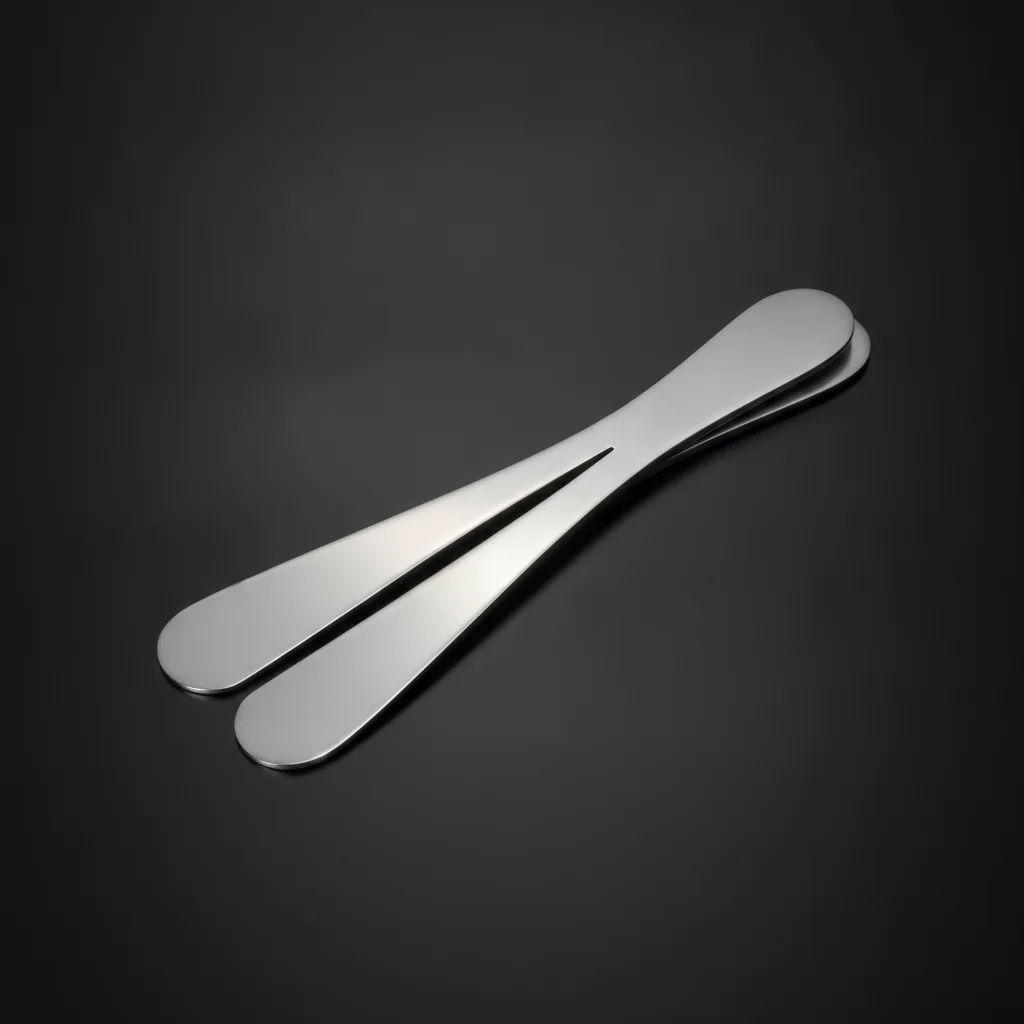
Breast Dissectors — Pattern and Clinical Use
Creating an implant pocket means dissecting a precisely bounded space, either above or beneath the pectoralis muscle, through a small incision some distance away. The dissector is long, blunt and paddle-shaped so it separates tissue planes by sweeping rather than cutting, and defines the pocket margins without perforating into adjacent tissue.
Because the dissection is largely blind and the pocket boundaries determine implant position, instrument length and tip shape are what let the surgeon feel where the pocket edge is. Some patterns incorporate a light source or suction channel.
Breast Dissectors Variants and Specifications
Standard breast dissector patterns.
| Variant | Specification / use |
|---|---|
| Paddle-tip dissector | Sweeping plane separation |
| Blunt curved dissector | Defining pocket margins |
| Lighted dissector | Illuminates the blind pocket |
| With suction channel | Clears fluid during dissection |
| Long, 25–30 cm | Reaching the far pocket edge |
| Malleable pattern | Contoured to the chest wall |
Material, Finish and Quality Control
We forge Breast dissectors from 316L austenitic stainless. All edges are radiused and polished, since the instrument sweeps blind through tissue planes and must separate rather than cut. Each batch passes Rockwell hardness testing, dimensional checks on edge radius and surface polish, and visual inspection under our ISO 13485 system before passivation and final finishing. Mirror and satin finishes are both available — satin is usually specified where glare under operating lights is a concern.
Who Sources Breast Dissectors From Surgical Star
Breast dissectors sell to aesthetic and reconstructive surgical distributors, with lighted patterns commanding a premium as surgeons seek better visualisation of a blind pocket.
OEM, Certification and Ordering
Every Breast dissectors can be produced as a private-label line: your logo laser-marked on the handle, your catalog numbers, and your own printed packaging, manufactured from your drawings or a reference sample. Manufactured under an ISO 13485 quality system, CE-marked to EU MDR 2017/745 and covered by US FDA establishment registration. A certificate of conformity and an ASTM F899 material certificate for the exact steel grade ship with your order.
MOQs are low and new-brand friendly, and vary with pattern, finish and branding. Pricing is direct from the factory and tiered by volume. After you approve a branded pre-production sample, bulk production typically runs four to six weeks and ships worldwide DDP with HS codes handled. See how OEM & private label works →
Related Plastic & Reconstructive Surgery Instruments
Frequently Asked Questions
Why must the dissector be blunt?
It separates tissue planes by sweeping rather than cutting, which keeps the pocket boundaries clean and avoids perforating into adjacent tissue.
What is a lighted dissector?
One with an integrated light source that illuminates the implant pocket, which is otherwise dissected largely blind through a distant incision.
Why are they so long?
The incision is often some distance from the far edge of the pocket, so the instrument must reach the whole dissection from a single small access.
Can you manufacture these under our own brand?
Yes — full OEM and private label. We laser-mark your logo and catalog numbers, pack in your branded boxes, and work from your drawings, tech pack or a reference sample, with a pre-production sample approved before any bulk run.
Send your pattern list, drawing or a reference sample and we’ll quote MOQ, pricing and lead time — standard catalog or fully private-label.
Request a Free Quote Order a Sample