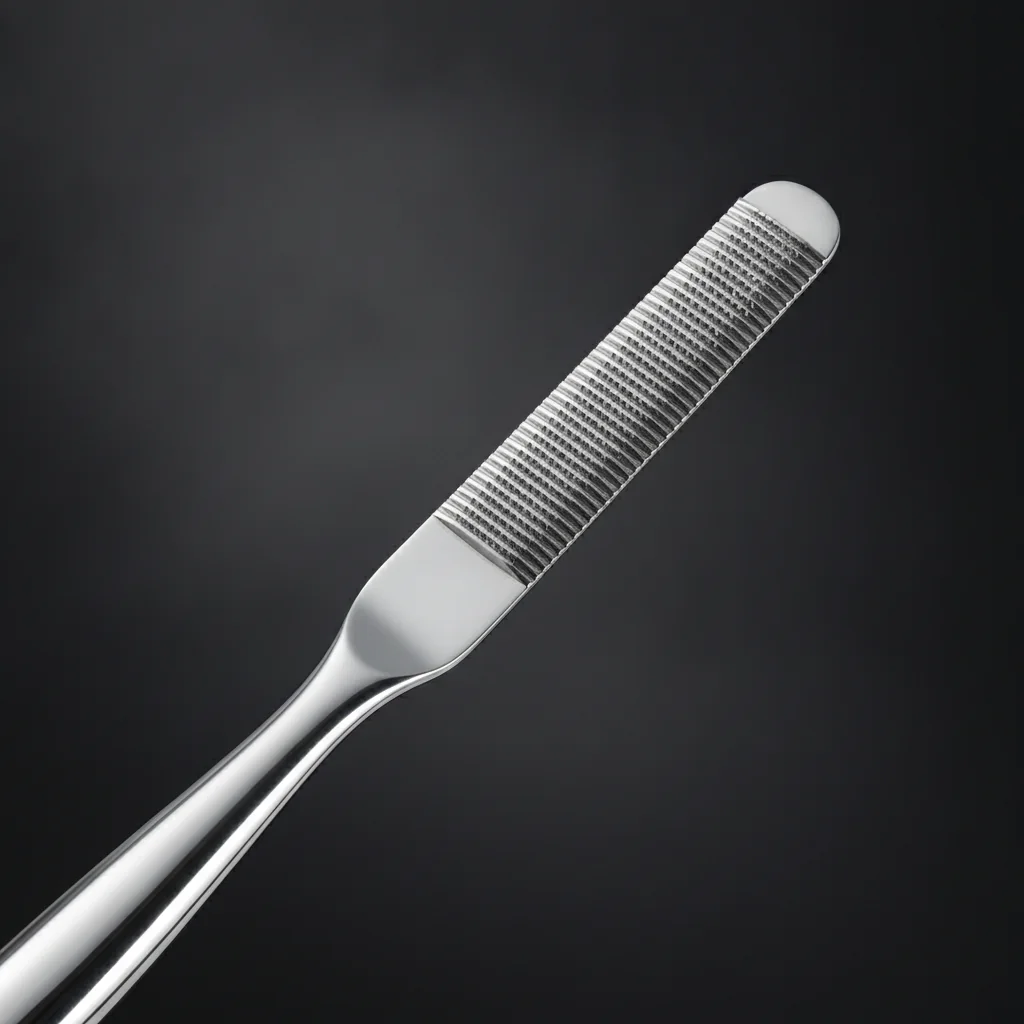
Callus Rasps — Pattern and Clinical Use
After the bulk of a callus is pared with a blade, the surface is smoothed with a rasp so the remaining skin is even and does not form a new pressure point at the edge of the debrided area. The rasp is drawn across the skin in one direction, and the cut of the abrasive surface determines how quickly material is removed and how smooth the finish is.
Podiatric rasps must be sterilisable, which distinguishes professional instruments from retail foot files. Stainless rasps with a machined or applied abrasive surface withstand autoclaving, while many consumer files do not.
Callus Rasps Variants and Specifications
Standard callus rasp patterns.
| Variant | Specification / use |
|---|---|
| Coarse cut | Rapid callus reduction |
| Fine cut | Smoothing and finishing |
| Double-sided coarse/fine | Both stages in one instrument |
| Curved surface | Follows the plantar contour |
| Flat surface | Broad callus areas |
| Autoclavable stainless | Professional reprocessing |
Material, Finish and Quality Control
We forge Callus rasps from AISI 420 martensitic stainless. Abrasive surface uniformity is checked and autoclave resistance verified, since professional rasps must survive repeated sterilisation. Each batch passes Rockwell hardness testing, dimensional checks on abrasive uniformity and autoclave resistance, and visual inspection under our ISO 13485 system before passivation and final finishing. Mirror and satin finishes are both available — satin is usually specified where glare under operating lights is a concern.
Who Sources Callus Rasps From Surgical Star
Callus rasps sell to podiatry and chiropody distributors as autoclavable professional instruments, distinct from the retail foot-file market.
OEM, Certification and Ordering
Every Callus rasps can be produced as a private-label line: your logo laser-marked on the handle, your catalog numbers, and your own printed packaging, manufactured from your drawings or a reference sample. Our quality file is ISO 13485, our EU route is CE marking under MDR 2017/745, and our facility holds US FDA establishment registration. Conformity and ASTM F899 material certificates are issued against each order.
You order direct from the factory with no trading-house margin, on volume-tiered pricing and a minimum matched to your pattern and finish. Once your branded sample is signed off, expect roughly four to six weeks to bulk delivery, worldwide DDP. See how OEM & private label works →
Related Podiatry Instruments
Frequently Asked Questions
How do professional rasps differ from retail foot files?
Professional rasps are stainless and autoclavable, so they can be sterilised between patients. Most consumer files cannot withstand autoclaving.
Coarse or fine cut?
Both. Coarse reduces callus bulk quickly, fine smooths the finish so no new pressure edge forms. Double-sided rasps carry both.
Why smooth after paring?
An abrupt edge at the debrided margin becomes a new pressure point. Smoothing blends the treated area into surrounding skin.
Can you manufacture these under our own brand?
Yes — full OEM and private label. We laser-mark your logo and catalog numbers, pack in your branded boxes, and work from your drawings, tech pack or a reference sample, with a pre-production sample approved before any bulk run.
Send your pattern list, drawing or a reference sample and we’ll quote MOQ, pricing and lead time — standard catalog or fully private-label.
Request a Free Quote Order a Sample